What does color really do in photography?
What does color really do in photography?
We often talk about color, but images show it better. During the workshop, I always try to incorporate the ideas of the attendees into the sets.
Even if I think it won’t work, because seeing is believing and is the best way to learn. And in all honesty, sometimes my conclusion is also “yes, that works great”
So always experiment, it’s the best way to learn and get some creative results. This blog is about what color really does in photography.
Today, we focus on using some different colors in the same setup.
These were shot during one of the sets with our model Nadine.
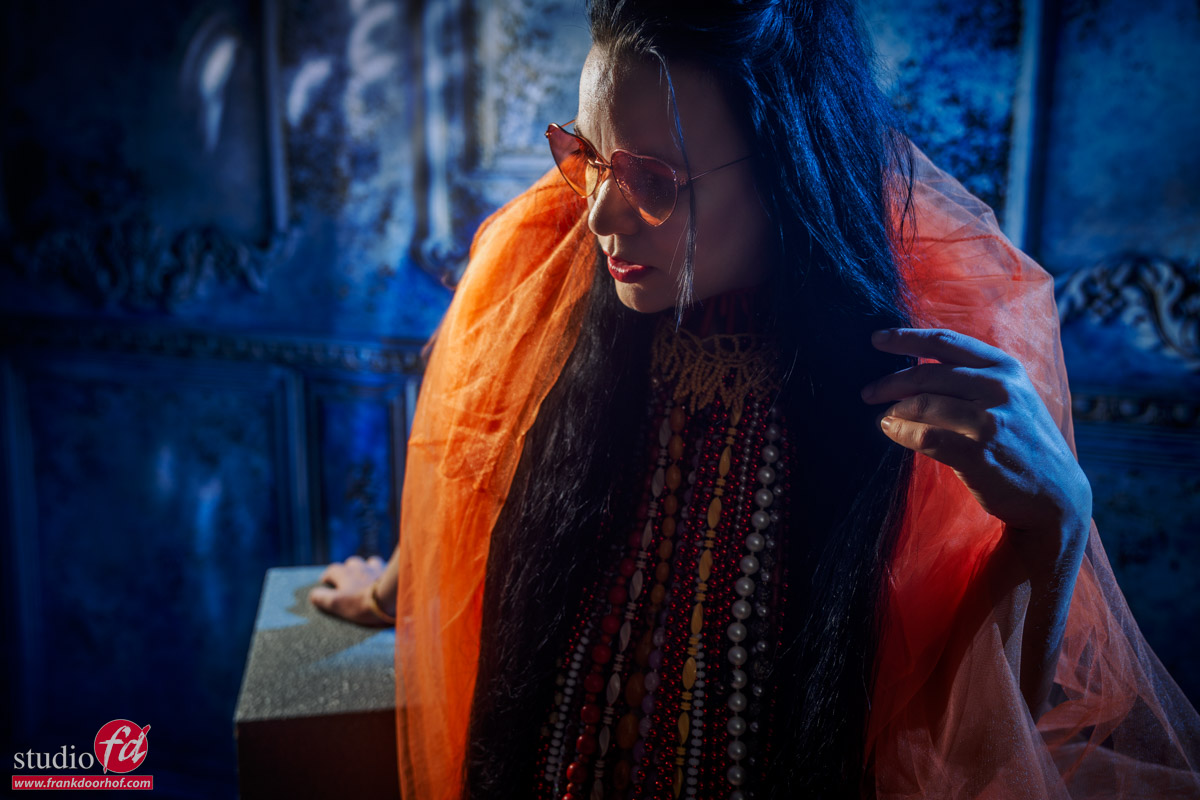
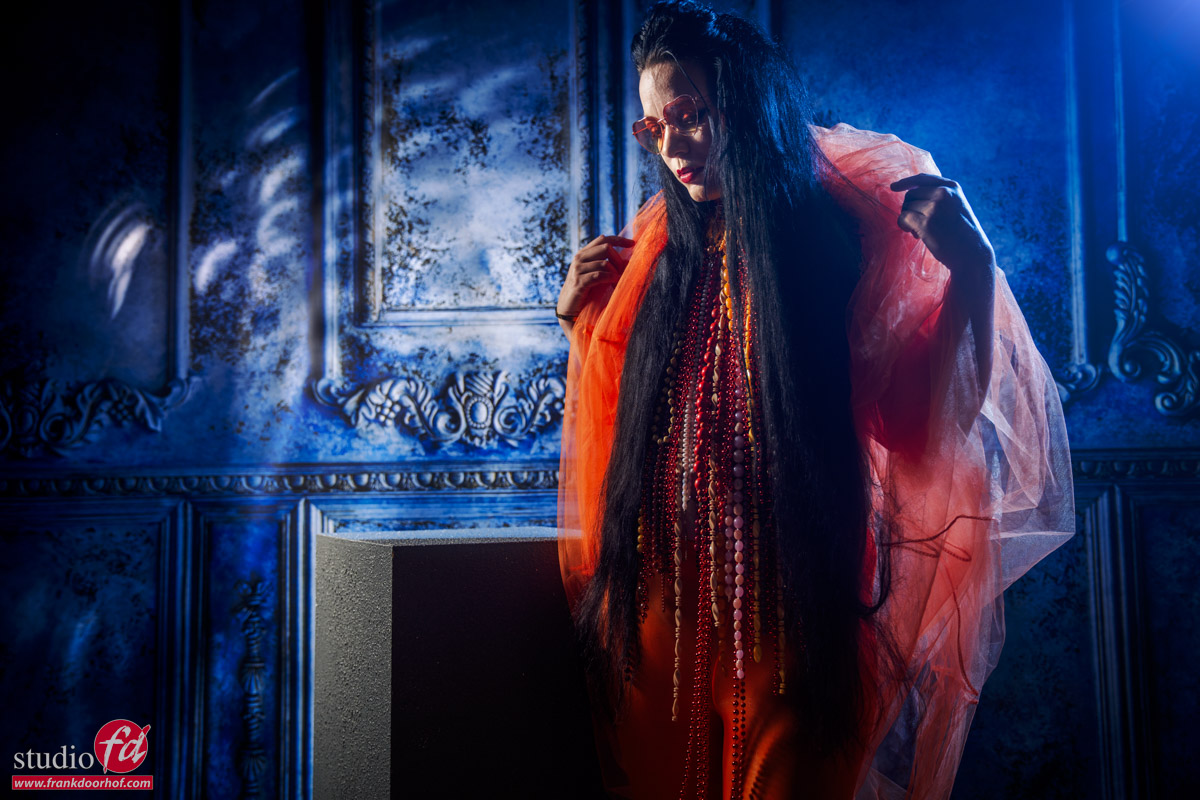
Let’s first take a look at the first start image.
In this image, I’m using our new Geekoto Beautydish without the diffusion material but with the grid; this way, I get some interesting effects on the background and model.
As an accent light, I’m using the Geekoto GT200 with the Rogue magnetic system and a blue gel
I love this effect with our background. The blue color nicely blends together and the effect on the orange gives me a nice contrast.
So what would happen if we changed the blue for green?
Personally, I hardly use green in my sets. For me, Blue and Red are colors that have a very strong emotional link. Also, red and blue nicely blends together with most other colors, where green can be a very dominant “attention point”.
So let’s try this.
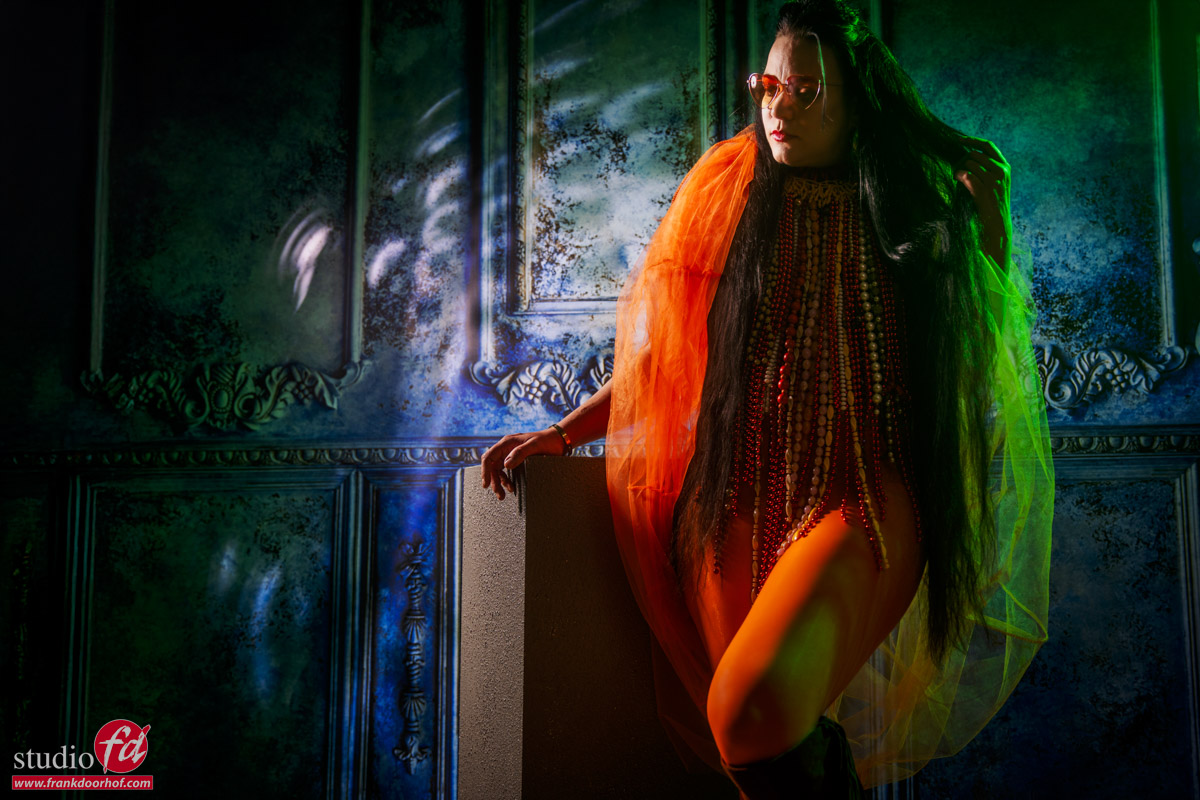
Is it really ugly?
Not really, but for me it takes away the feel I had with the blue.
Now, do remember that this can change depending on where in the world you live; there are cultures where colors will evoke totally different feelings. So when you do commercial work in different regions, it might be great to check this beforehand 😉 This blog is about what color really does in photography, so let’s go back to blue but a bit more.
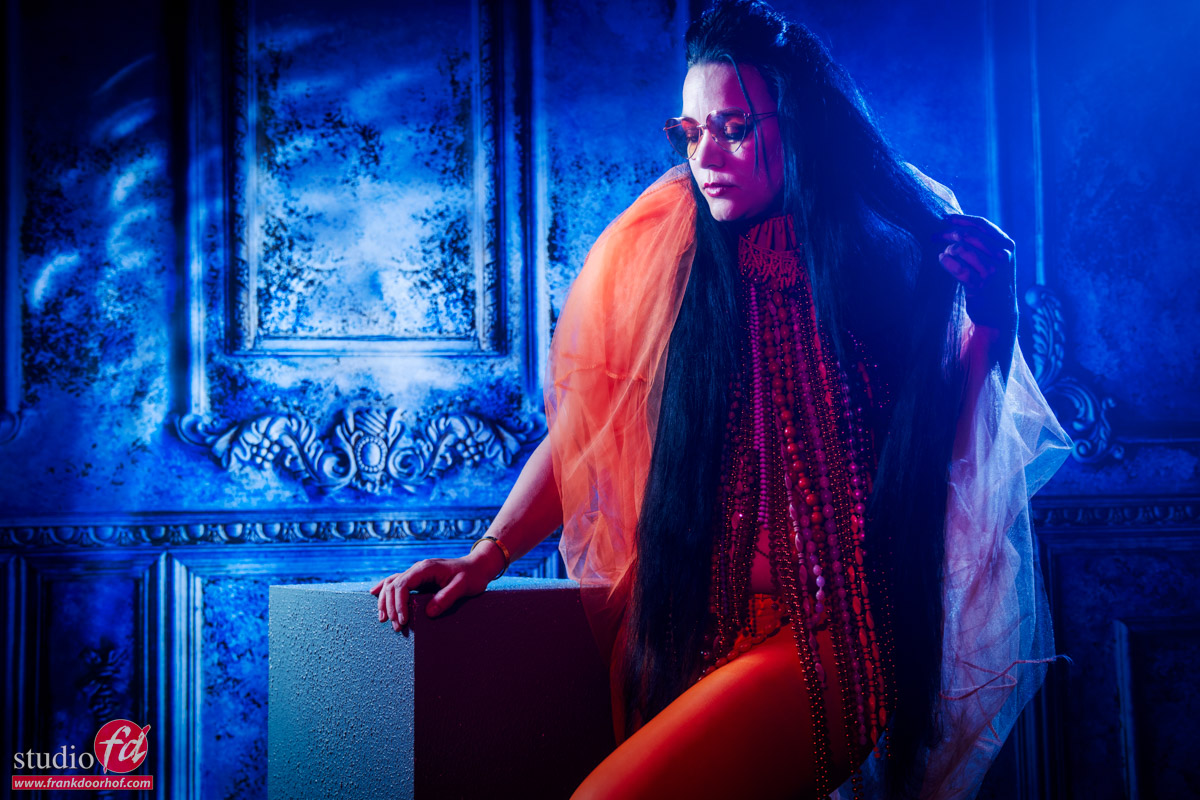
For some sets, it might be “a lot”. But for this kind of setup, I think it actually works very well. It’s a totally different look than the more subtle blue.
A quick in-between tip. If you are afraid to blow out details in bright clothing/materials? Make sure to feather your light away from the subject but aimed at the camera. This way, the camera will get the full power output, and your subject is hit by the side of the light, which is nice and soft but also a lot lower in output.
Anyway, now that we have seen blue…how about red ?
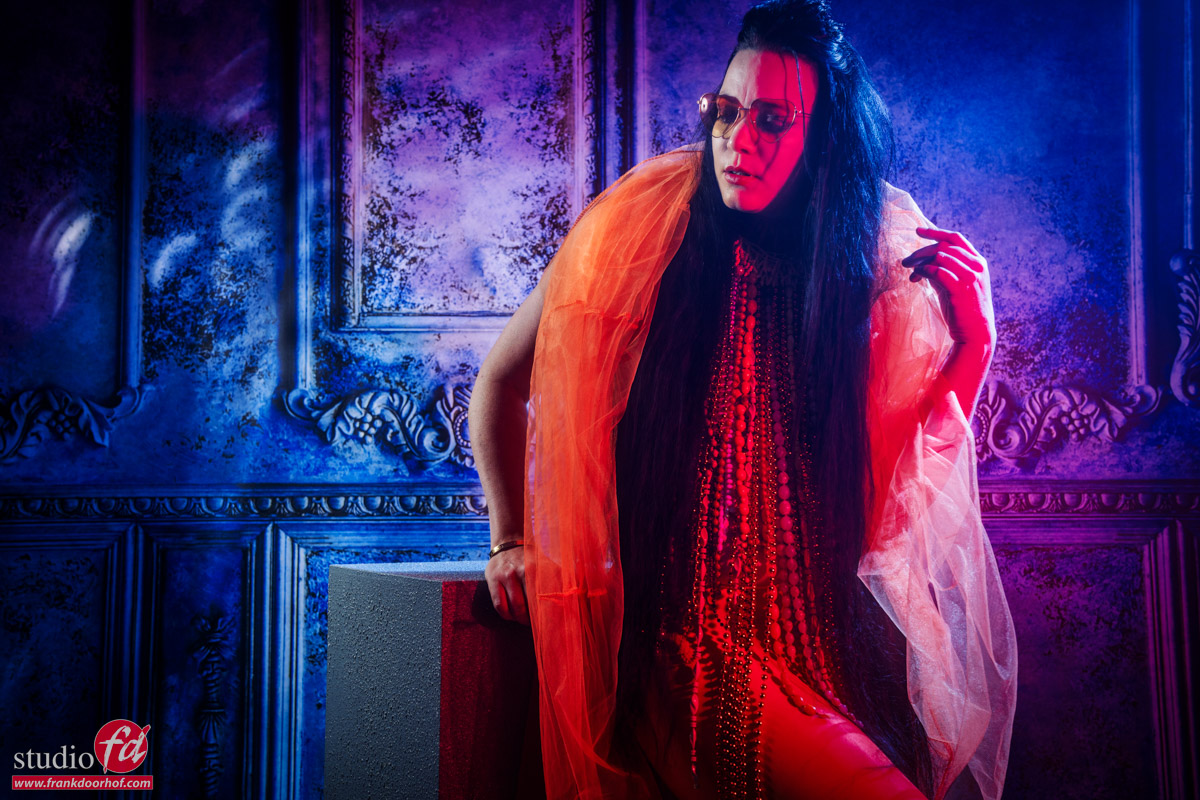
You probably already spotted it.
We are still using the blue gel, but I also added a red gel to the set.
For me, this shot is one of my favorite shots; it’s way over the top, but in this setting, I think the blue and red blend together really nicely.
Conclusion about what color really does in photography
Color evokes emotion and can really change the mood of a shot or even destroy it.
For me, I try to follow the 60-30-10 rule a “Little bit”, meaning 60% of a set is the main color, 30% is something in the same family, and 10% is a strong accent color. This is a technique that has been used in films for ages. And although it’s not a golden rule, it will create stunning effects. The combination of the red material and the blue background already set the mood. By adding green, I’m actually adding a third element in a set where two elements were already competing with each other.
Shooting tethered can help a lot in visualizing the effects more clearly.
Also, read this blog about Prince, the look-alike photoshoot
Or this video about getting a witch right in camera, with leds and strobes
Workshops
Want to learn everything about light control?
Want to visit a workshop where it’s not just shooting a model with a fixed lighting setup, but see how the setup is build and adjusted to the taste of the group?
And of course learn how to work with poses, backgrounds, small sets, styling, retouching and a lot more…..
If this all sounds awesome, visit fotografie-workshops.nl and book your workshop.
If you don’t speak Dutch, no problem, let us know a few weeks in advance and we can switch the workshop to English.
Not possible to travel to The Netherlands?
We got you covered with our 1:1 online workshop.
We have a full streaming setup in our studio. 4 detail cameras and of course the retouching software so you can see every detail and of course ask questions during the day. Plus you get all the RAW files after the workshop.