Tag Archive for: reflections

Plexiglas is great for backdrops

Do you hate wrinkles in the floor?

With most photographic backgrounds, you risk wrinkles on the floor.
Models walk around, and if you want the floor to be 100% wrinkle-free, you can, of course, opt for vinyl or ProFabric, but when you use materials like ProFold or other softer materials, we have a solution for you.
And the cool extra benefit… it gives a great reflection on the floor, especially with seamless paper; it can be a great way to spice up a shot. In fact, for perfect white backgrounds, I find plexiglass vital to get a natural effect and cool reflection.

Today, I show you how we use it on our ProFold background material

Reflections and how to use them creatively

Today a bit more about reflections

In my previous blogpost I shared the link to the digital classroom episode about reflections.
Today let’s take a look at the results and give you some information about how I shot them.

Set 1

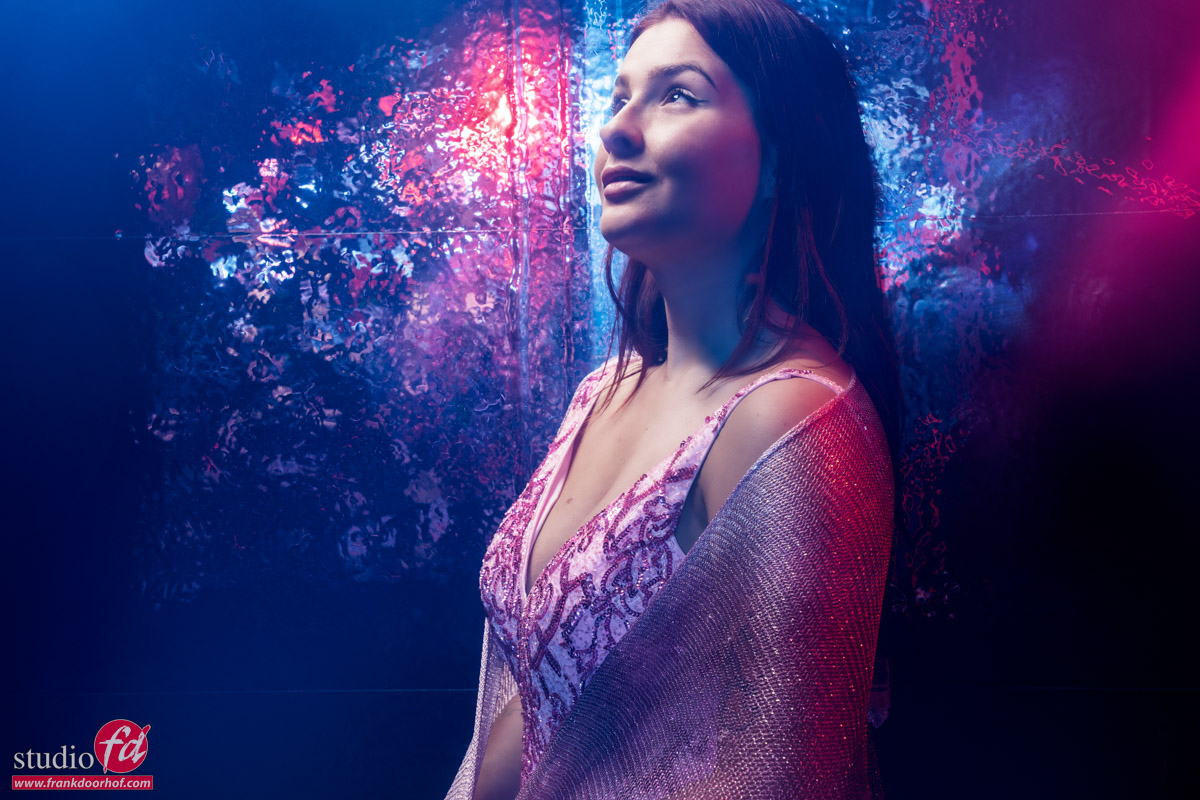
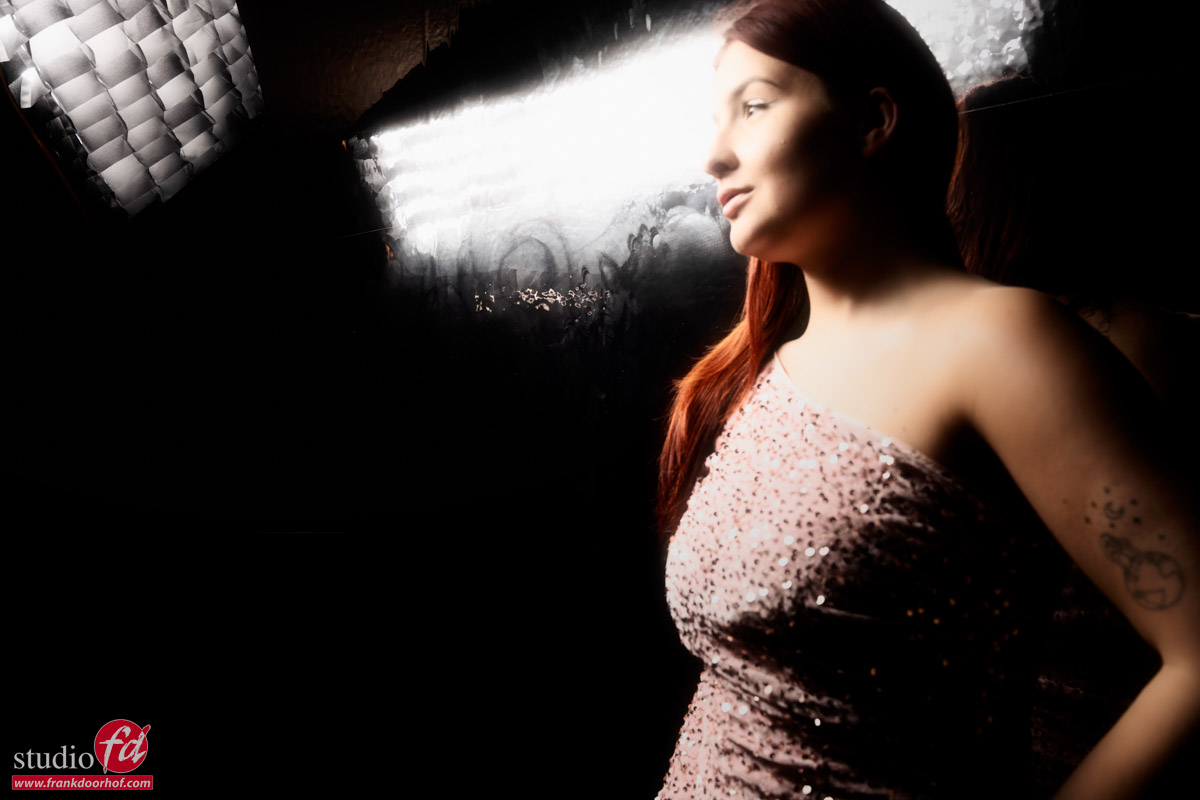
Here you see our model Lisa leaning against a wall that is covered with wallpaper that is sold, at for example Amazon, as mirror wallpaper.
I have to be honest, the effect is very cool, but it’s far from a mirror which you could use to comb your hair.

For a setup like this, the first thing you have to make sure is that there are no reflections in the wall from your studio.
When you stand in front you will of course see the studio, but remember that when shooting with strobes you are overpowering the available light so if you push enough power to the set it will render the reflection to a very nice black wall with of course a cool reflection.

The second point is of course to make sure you don’t see the strobe in your viewfinder.
If you don’t see it in your viewfinder, it won’t show up in the final shot. There could be some lens flare of course but that can also be a nice addition to the shot.
We call this effect “angle of incidence is angle of reflection”, in other works, follow the lines and you know where the reflection will show up.
As soon as you’ve done this a few times it becomes almost second nature.

Set 2

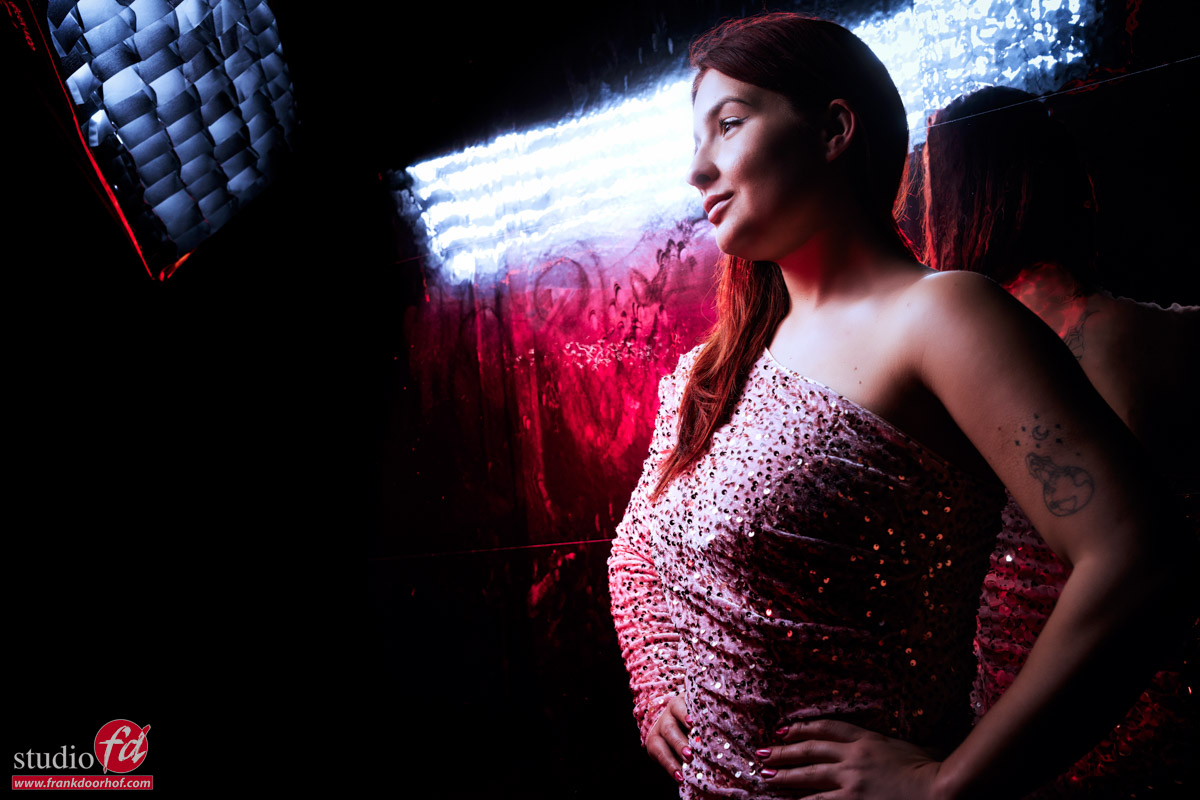
In the first set I did not want the reflections in.
But what if we are getting a bit more creative?
I have to be honest, this is a large amount taste.
Set 3

As you can already see in the last shot, I’m adding a red strobe.
Now you can use this strobe just as a fill in light, but you can also go a “bit” more extreme.
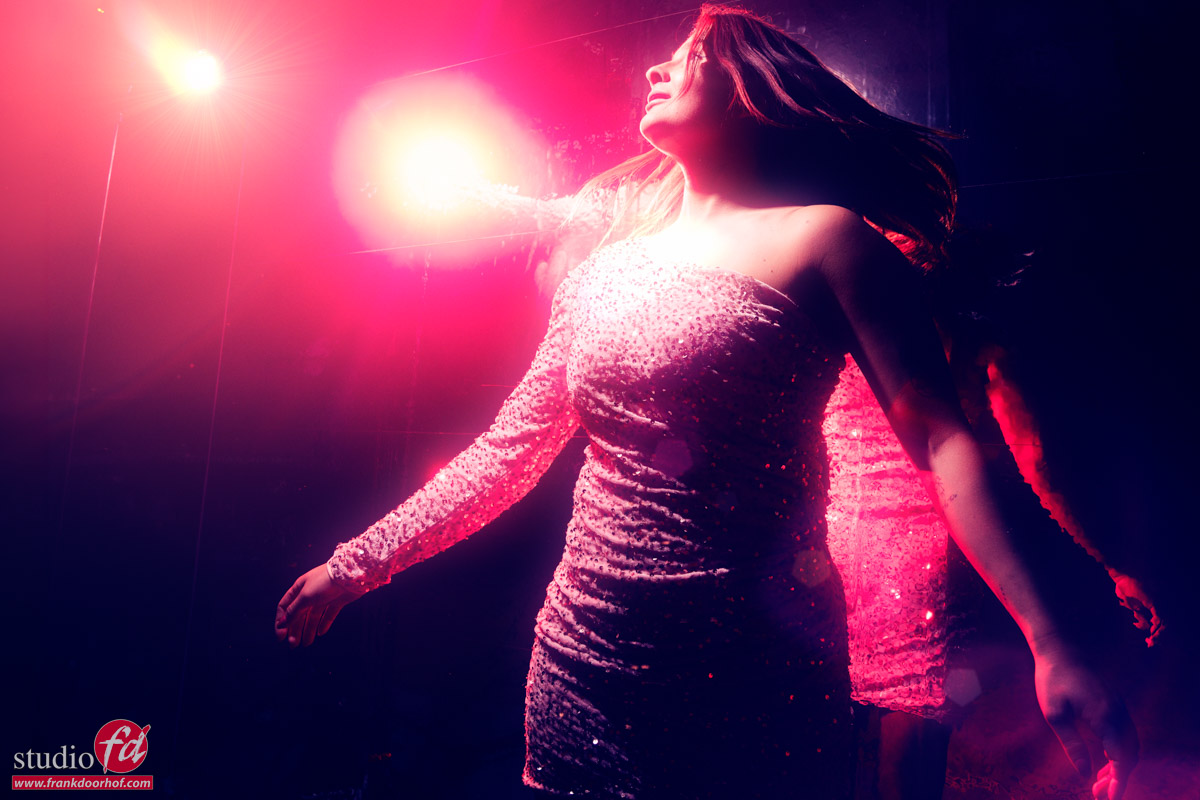
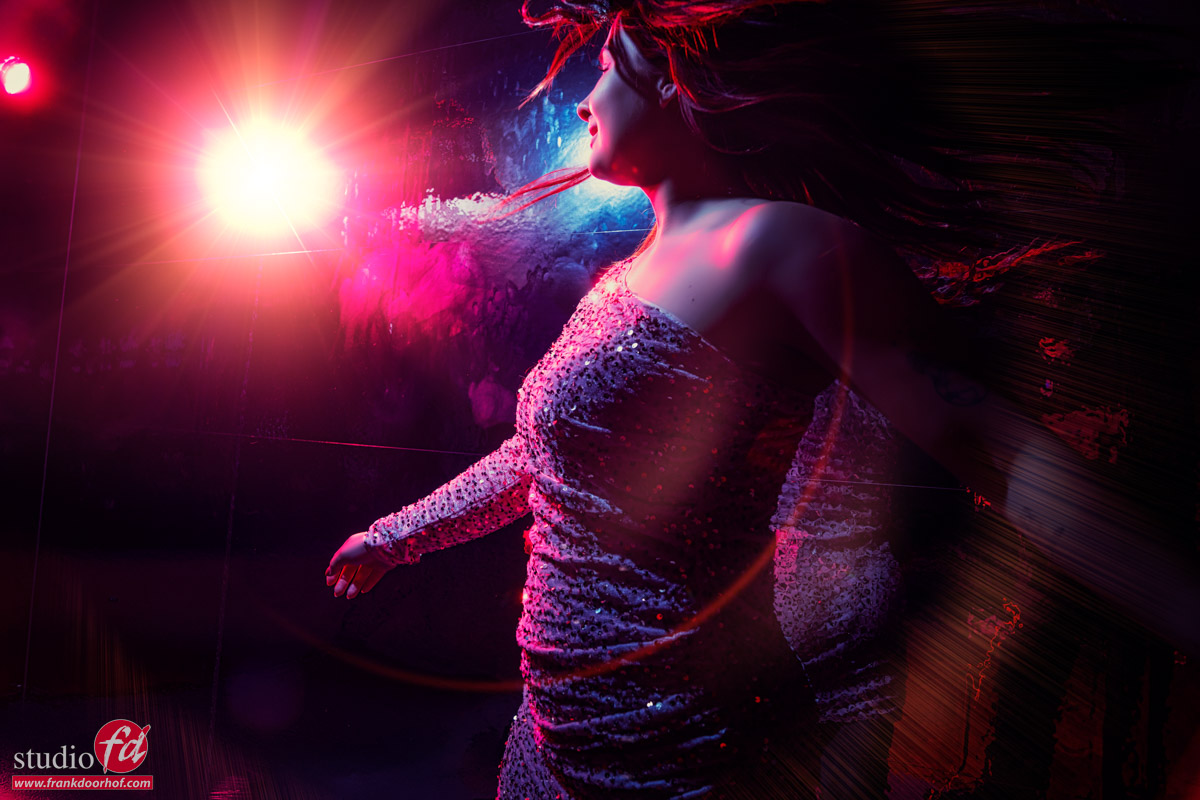
In the last image I’ve used a lens flare effect from BorisFx.
BorisFx is great software with loads of special effects including some very convincing lens flares.
I mostly use it for filmlooks and special color processing. But sometimes a lens flare can turn out not 100% perfect in the final results, or you want to add a bit more “oomph”
In that case BorisFx can really add something special.
I do feel that the lensflare/colored gels should be in place when shooting the image, just adding a lens flare when there was no lens flare does look nice, but also fake in cases like these.
But when it’s already in the shot, BorisFx can really add a lot of extra mood.

During the broadcast I also took a quick shot of the setup.
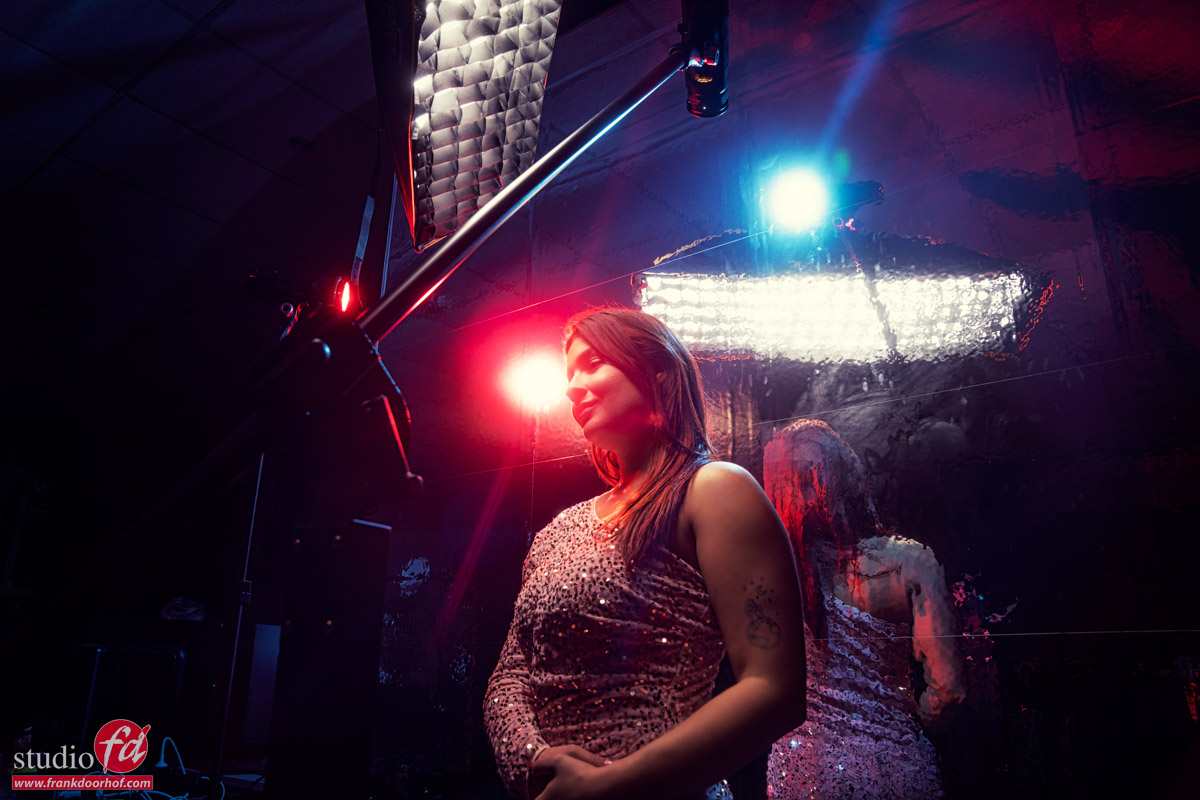
Yep, try to keep the reflections out, can be a challenge, so why not include them, right 😀

Set 4

For the next set we used a very nice mirror background.
I bought this for a few euros online and must be honest it’s one of the coolest things I bought for the studio in while.
In fact you can use it in two totally different ways, so let’s start with option 1.
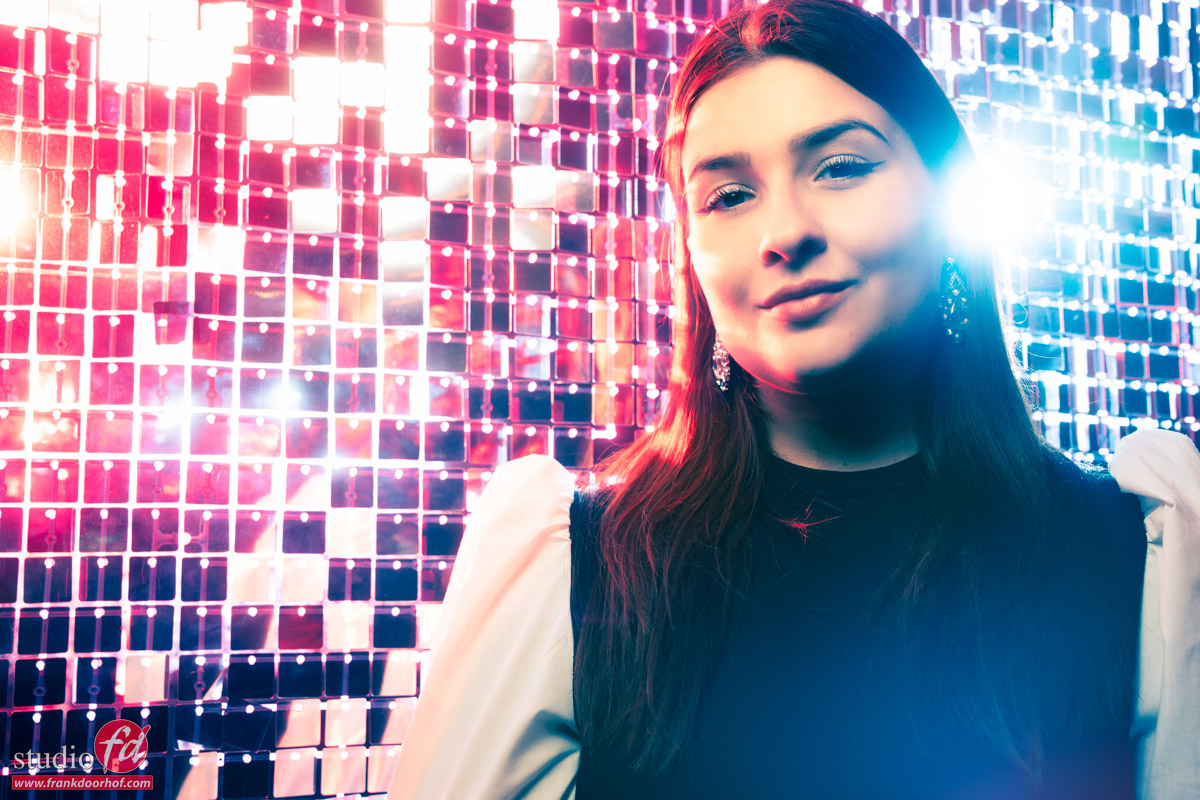
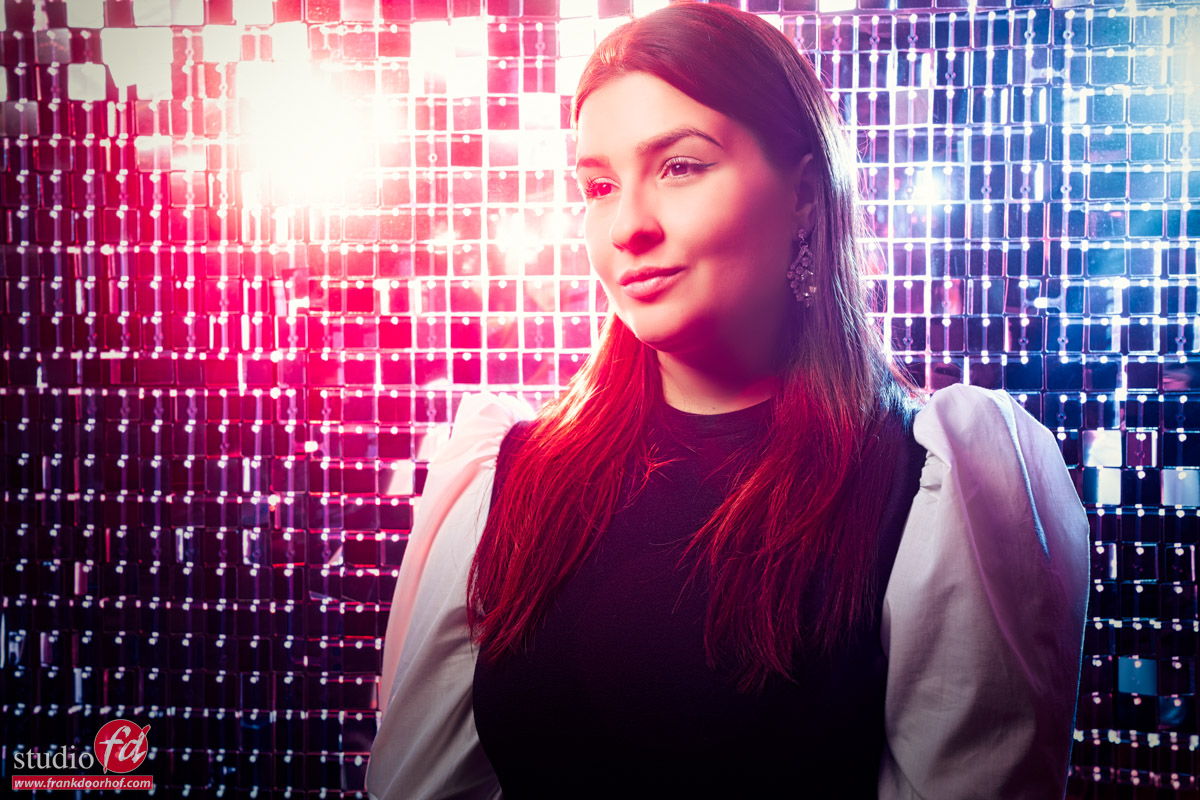
Here I’m using the background behind my model (duh), and placed two strobes behind the background.
Both the red and blue gel can be angled to get different results, if you just want to blend the colors, use a sort of cross setup, of you want to have some cool lens flare effects you can for example aim one of the strobes forward. Also make sure to experiment with the light output, in these cases I love it when it almost blows out the background on some of the edges.

The final set

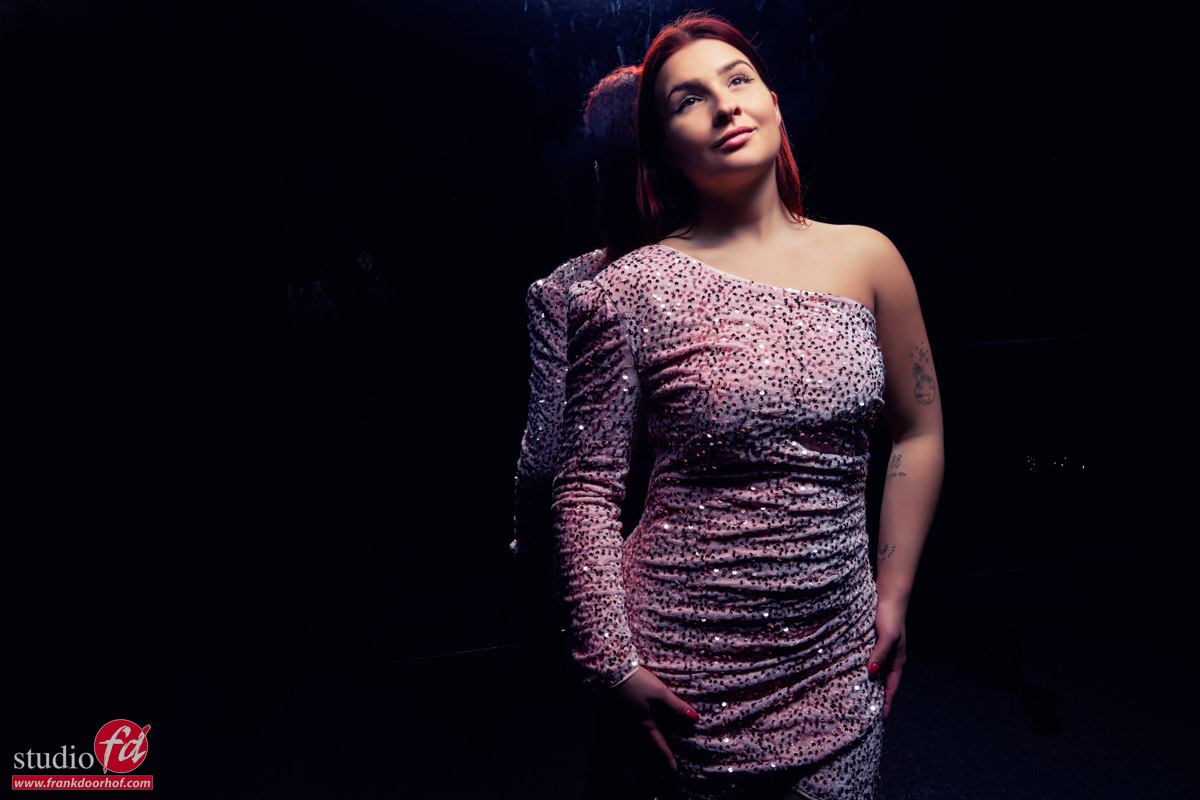
Let’s combine the mirror wallpaper and the mirror wall for the final setup.
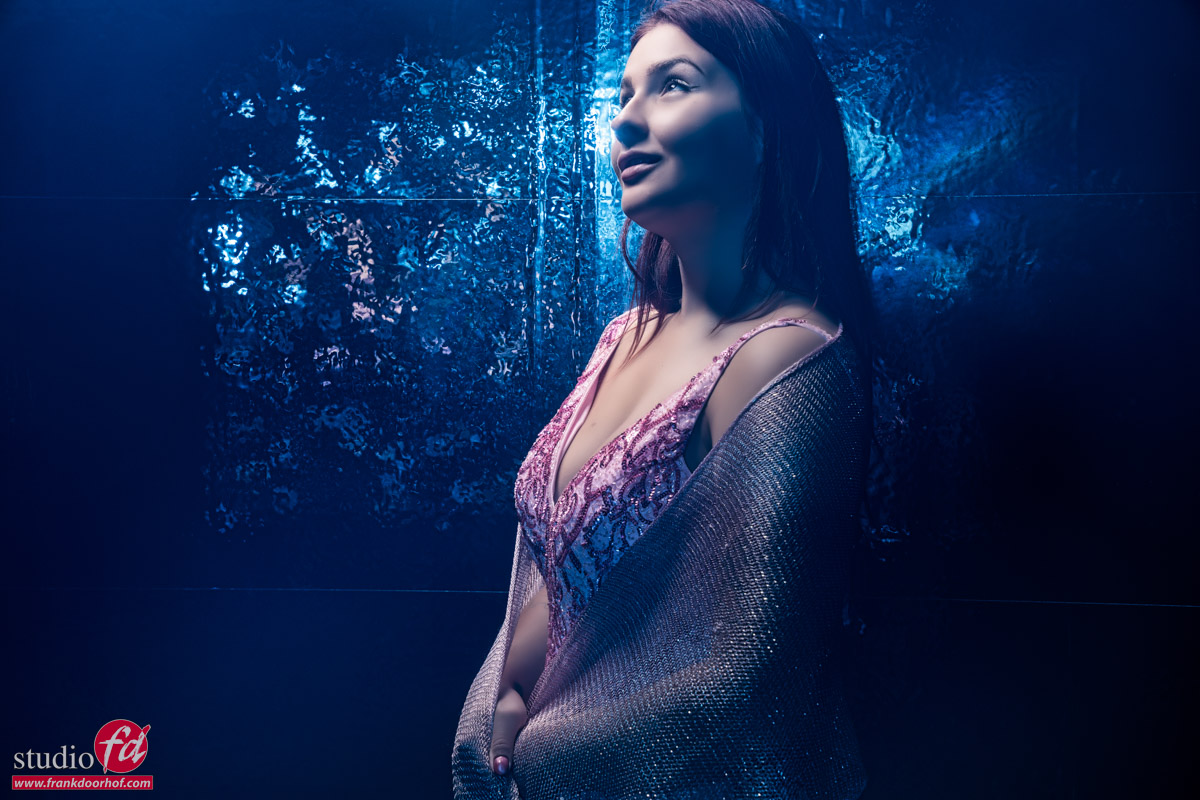
I’ve placed the small mirrors in front of the model.
Two strobes are aimed at the mirrors to reflect the light back on the model who is standing against the mirror wallpaper wall.
This way you don’t only get a very cool shimmer effect, but also a very nice blend of the red and blue gels.
By varying the output you can mix the colors of course.
Another cool thing you can do is shoot with one of the strobes aiming slightly towards the camera, this way you can get a blue or red “haze” in the shot due to lens flare.
It’s not as obvious as the lens flares from the back, but the effect is something I use a lot to spice up a shot.
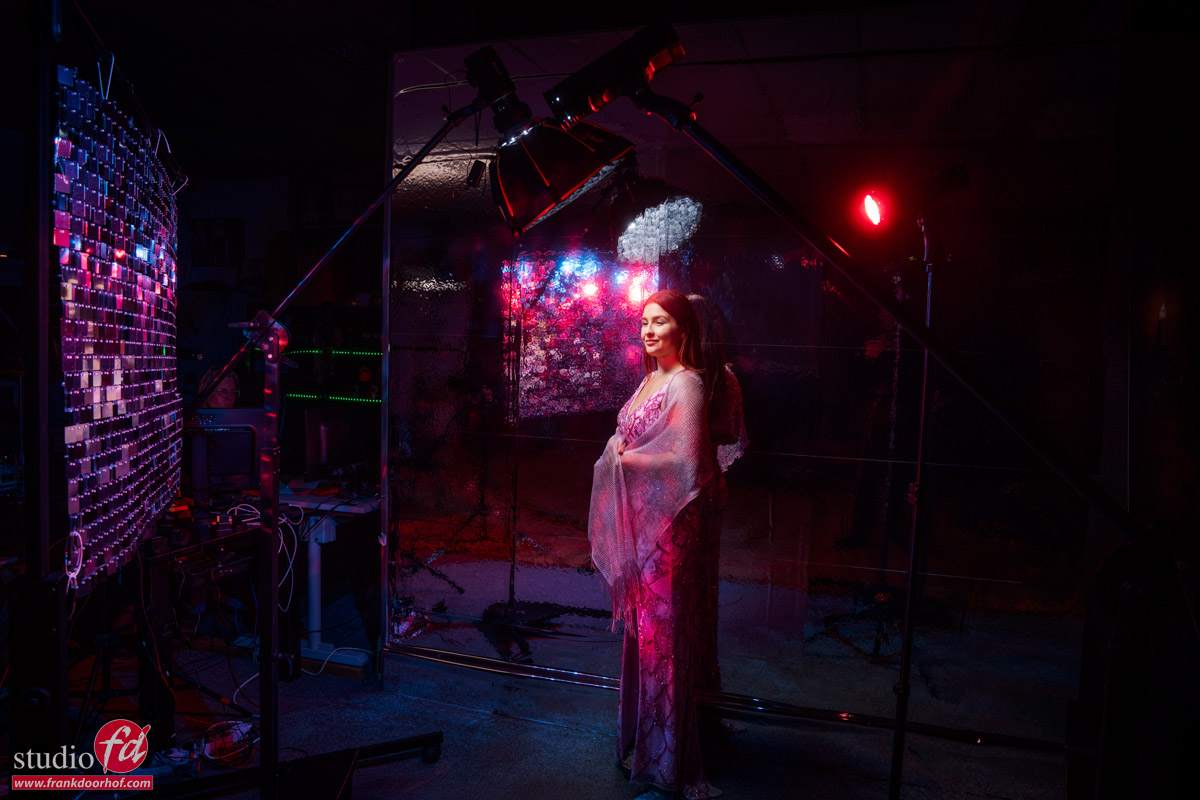
Here you can see the setup.
Two Geekoto strobes with the Rogue magnetic system on the background and our Geekoto Quicky softbox on the model.

Conclusion

I hope you enjoyed todays blogpost.
The images were shot during the live broadcast.

Want to learn everything about light control?
Want to visit a workshop where it’s not just shooting a model with a fixed lighting setup, but see how the setup is built and adjusted to the taste of the group?
And of course learn how to work with poses, backgrounds, small sets, styling, retouching, and a lot more…..

If this all sounds awesome, visit fotografie-workshops.nl and book your workshop.
If you don’t speak Dutch, no problem, let us know a few weeks in advance, and we can switch the workshop to English.
Not possible to travel to the Netherlands?
We got you covered with our 1:1 online workshop.
We have a full streaming setup in our studio. 4 detail cameras and of course the retouching software, so you can see every detail and of course ask questions during the day. Plus, you get all the RAW files after the workshop.

Solve the biggest problem in Photography

One of the biggest problems in photography is probably reflections

We all know this nasty reflections in backgrounds, glasses, cars etc.
Always in locations where you don’t want them.
But in essence they are pretty easy to solve, so we thought it would be a great idea to dedicate a full digital classroom episode to the topic reflections.

A few weeks ago we installed a new reflective wall in our studio, and that’s of course the perfect wall to demonstrate the lighting setups.
In this 2 hour episode of digital classroom I show you how things can go wrong, how to see the reflections and how to prevent them, but also how to become very creative with reflections.

I hope you enjoy this episode.
We really appreciate a like, subscribe but most of all share our channel to your friends and fellow photographers so we can record more content.

Cheap can be more fun than you think

Is gear important?

I hear it all the time: the focus on gear.

“My lens is cheap,” “I have an old camera,” “I only have one strobe,” etc.
In all honesty, of course, gear is important, but you can create awesome art/photos, etc., with your phone nowadays. My motto over the year has been, “If people look at the quality of the pixels, the image is not strong enough.” That doesn’t mean you can just “wing” it and not care about your gear, but it shouldn’t be the main focus.

The same goes for sets. They are important too.
When people look at my portfolio, a lot of people don’t realize that most of the shots were taken during workshops or events. As you will understand, we don’t have a lot of time to create sets, and of course, we love to stay on budget, and that’s what today’s blog post is about: Cheap sets.

Fun and cheap sets

With photography, it helps when we don’t focus on light but on shadows; this is something you probably heard from day 1. The shadows tell you almost everything about the light source used, the angle, distance etc., but one step further is to realize we don’t really work with light but with reflections.
This also explains why we can use black reflectors to take out the shine on someone’s head, for example.

Reflections and shine

And don’t we just love it when something gets a beautiful “glow” in a shot?
Reflections can be a problem but also something really cool you can use in your image.
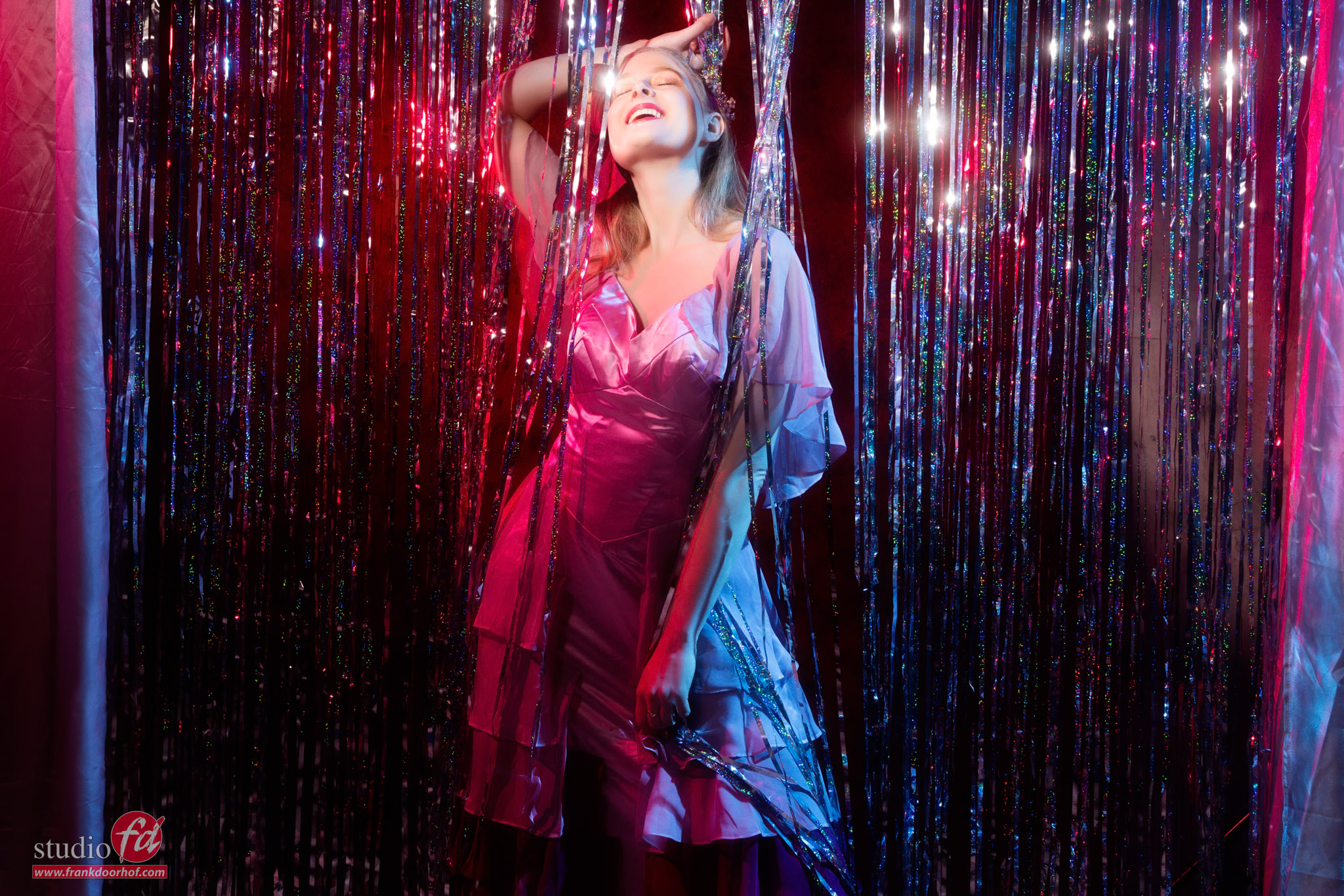
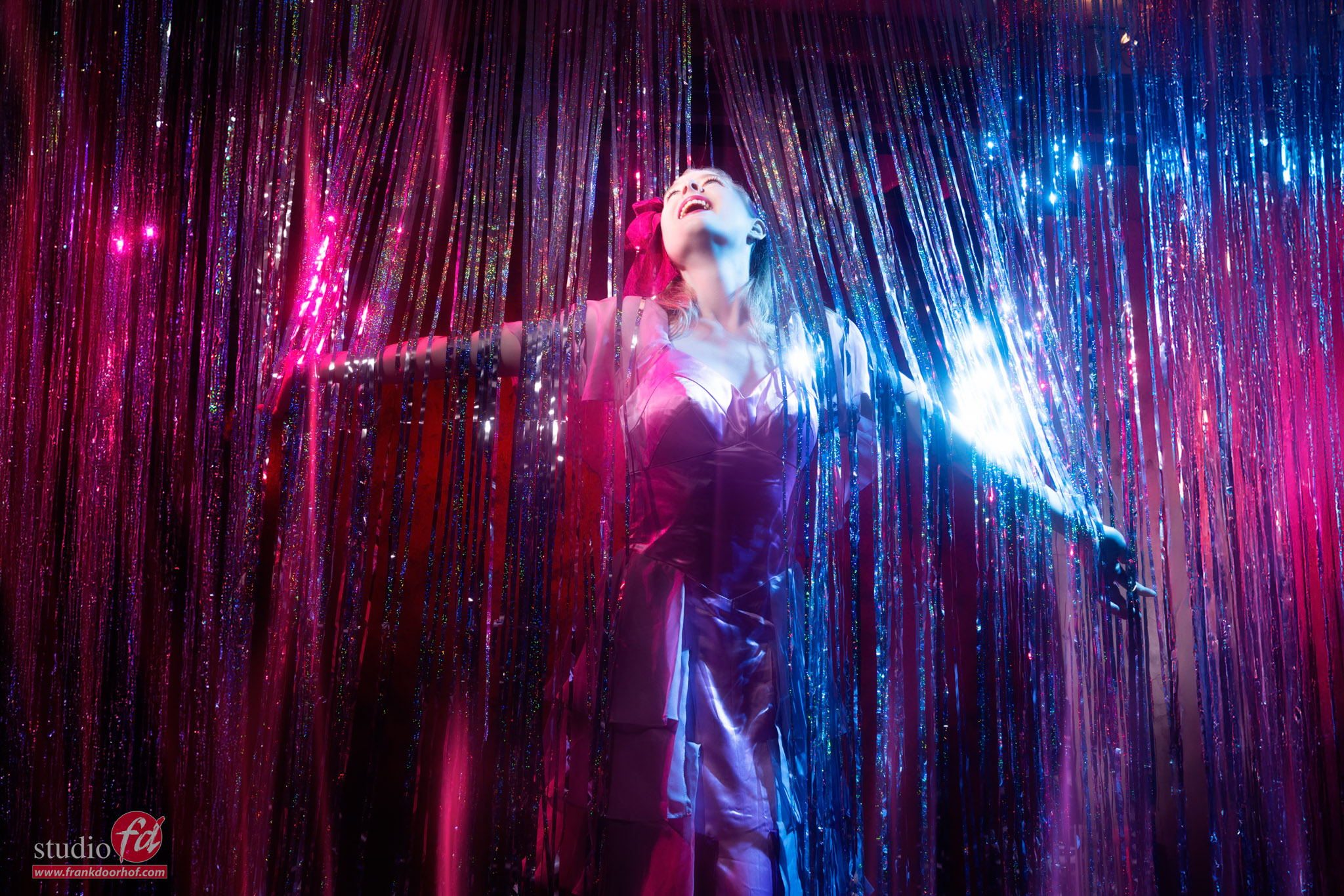
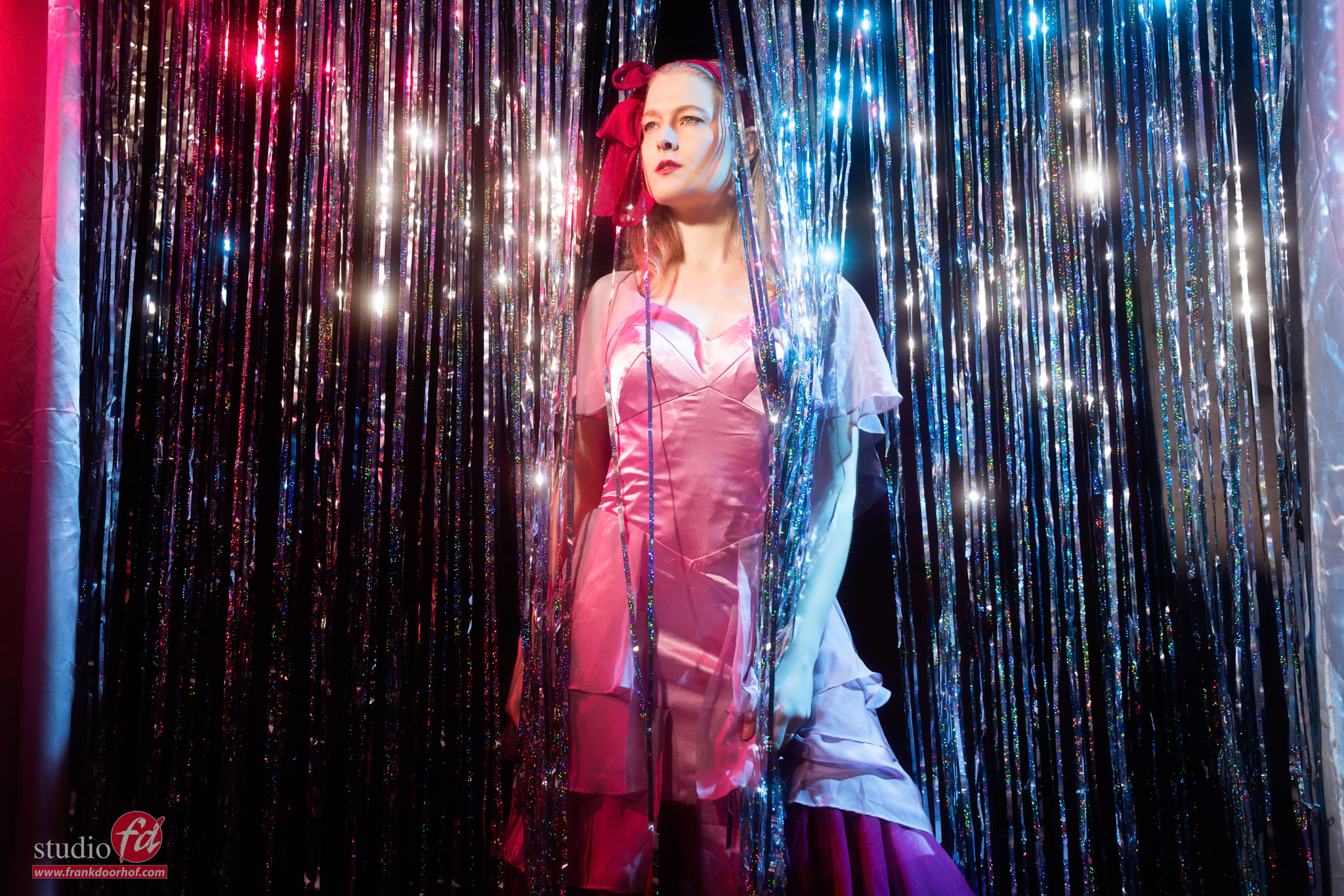
Today we take a look at some very cheap material you can buy in most party shops. It’s called (well, at least this one) holographic material, and we used it to build a nice background for one of the sets during a workshop. You can even get it in different colors.

A good technique is to use your phone and shine over the material; this will show you how the material reflects and should give you a good idea of how to use it in your shoot.

Fresnel for high contrast

When I used my phone to shine over this material, it immediately started to glow. So, for this setup, I knew we could hit the background with some harsh light for some extra contrast and “oomph” in the shot. If you shoot this with a soft box, it can work fine, too. But it will be a lot less extreme. So on the model, I’m using the Nanlite Fresnel spot (this is one of my favorite modifiers for a great classic high contrast look). The nice thing about a Fresnel is that you focus your light, and even when you use it on the extreme settings, it still has a wonderful effect on the skin of the model.

To make sure the material also shines and to get some nice color effects, I’ve placed two Geekoto GT200’s with the Rogue magnetic system with a red gel on one side and a blue gel on the other.

Together, they created a very nice blend of color and light on the model, plus the material gave a wonderful glow, especially when our model leaned forward.
So let’s take a look at the results from this setup, and in the next blog post, I show the behind the scenes video.

cheap sets

During the workshops, we always try to do 3-4 totally different sets, and this is just one :D. We often try to create cheap sets.
Also want to visit a workshop?
Visit fotografie-workshops.nl for more information. The workshops are in Dutch, but if you let us know a few weeks in advance, we can switch to English.
Don’t want to travel?
It’s also possible to book a full day 1:1 online workshop; see here for more info.