Tag Archive for: flash duration

Movement in a different way Part II

Today part II in our creative movement blogpost

Read part I here.

In the first part I used one strobe to freeze the model and than moved her face out of the frame to fill up the dark set with a large Nanlite Pavotube.
Today we are going one step further.

What if….

I’m not using one strobe but two?
There are a few ways you can do this.

First you could program an interval in your strobes.
Most strobes support multi sync where you can program the strobes to fire several times during the exposure, great for showing the trajectory of a racket or golfclub, or be more creative.
Today we are doing it differently.
Using second and first curtain sync is an option but only if you can SPLIT them between the strobes.

First curtain sync means the strobes fire immediately when the sensor opens.
Second curtain sync means the strobes fire at the end of the exposure.
You can see the effect when shooting a car in the dark. On the first curtain the car will seem to drive backwards, while on second curtain sync the car moves forward.
This setting is global when set in camera, some strobes can be programmed manually.

What if you have really dumb strobes?
In workshops I always try to use the advanced features as little as possible, I think the power of my workshops is that even with the cheapest strobes and modifiers you can create effects that come close to what we do during the workshops. So also for this set we are doing it in the most simple way, which actually gives you much more creativity, but later more on that.

Triggers

When I shoot myself I’m using the Geekoto commander.
The commander makes it possible to control the strobes from my camera in 4 different groups.
The commanders are however limited to the brand of your camera, and not all brands are supported of course.
That’s why during the workshops I’m using a Phottix radio trigger system, this way everyone can use the strobes.

The idea of this setup is to first fire the first strobe, and at the end of the exposure a second strobe.
To achieve this I use a shutterspeed of 2 seconds, I’m doing the same as in the first blogpost.
Make sure you use small light sources, in this case I’m using one Geekoto Quicky on the left side and one Geekoto S26 on the opposite side, both are aimed only at the face of the model, so they are using the grid and are place very close to the model to prevent too much light spill. Modeling lights are of course off.

One one strobe I’m using the receiver on channel 1 (don’t confuse this with groups).
On the other strobe I’m using the receiver on channel 2.
On my camera the transmitter that is sending channel 1 is active, and one of the students is holding a second trigger that is programmed on channel 2.
Now it’s just a matter of firing that second strobes somewhere at the end of the exposure. Or even two/three times.
Automatic is always easier of course, but this way you have much more creative options, although you do need an extra trigger of course.

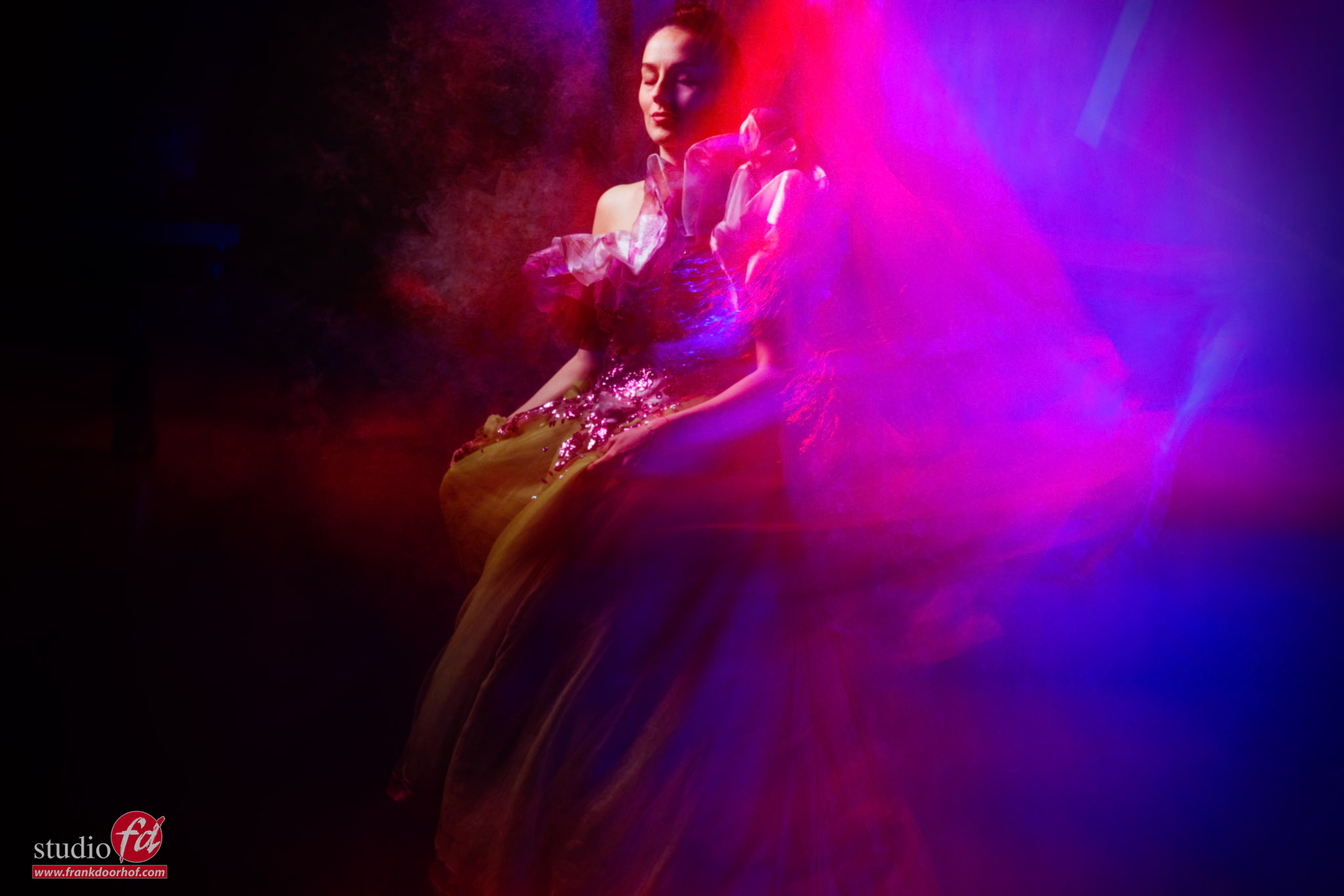
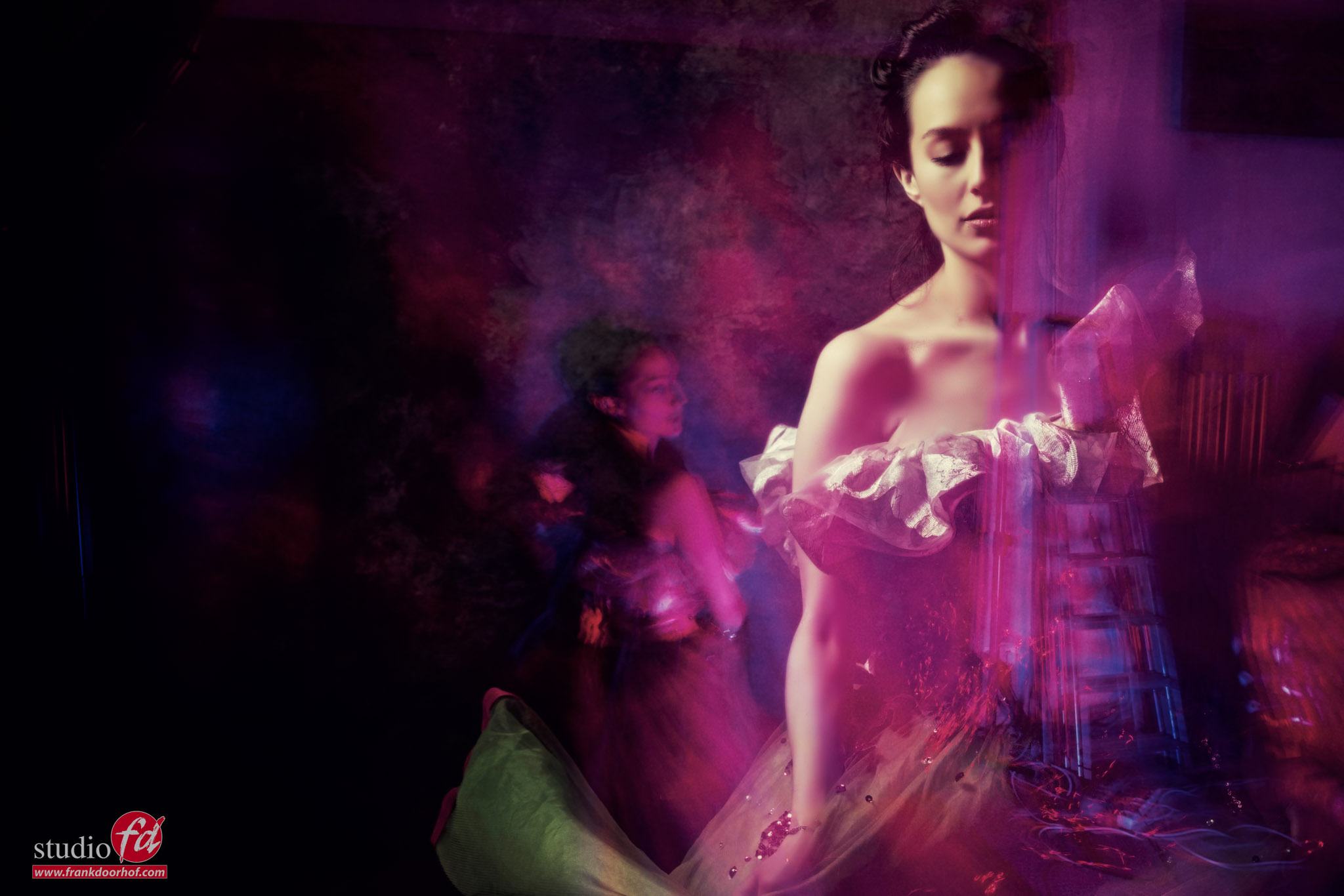
The results are even more difficult than we did in the previous blogpost.
I’m using zoom and tilt a lot for this setup, so getting great results is pure luck, but that’s the most part of the fun.

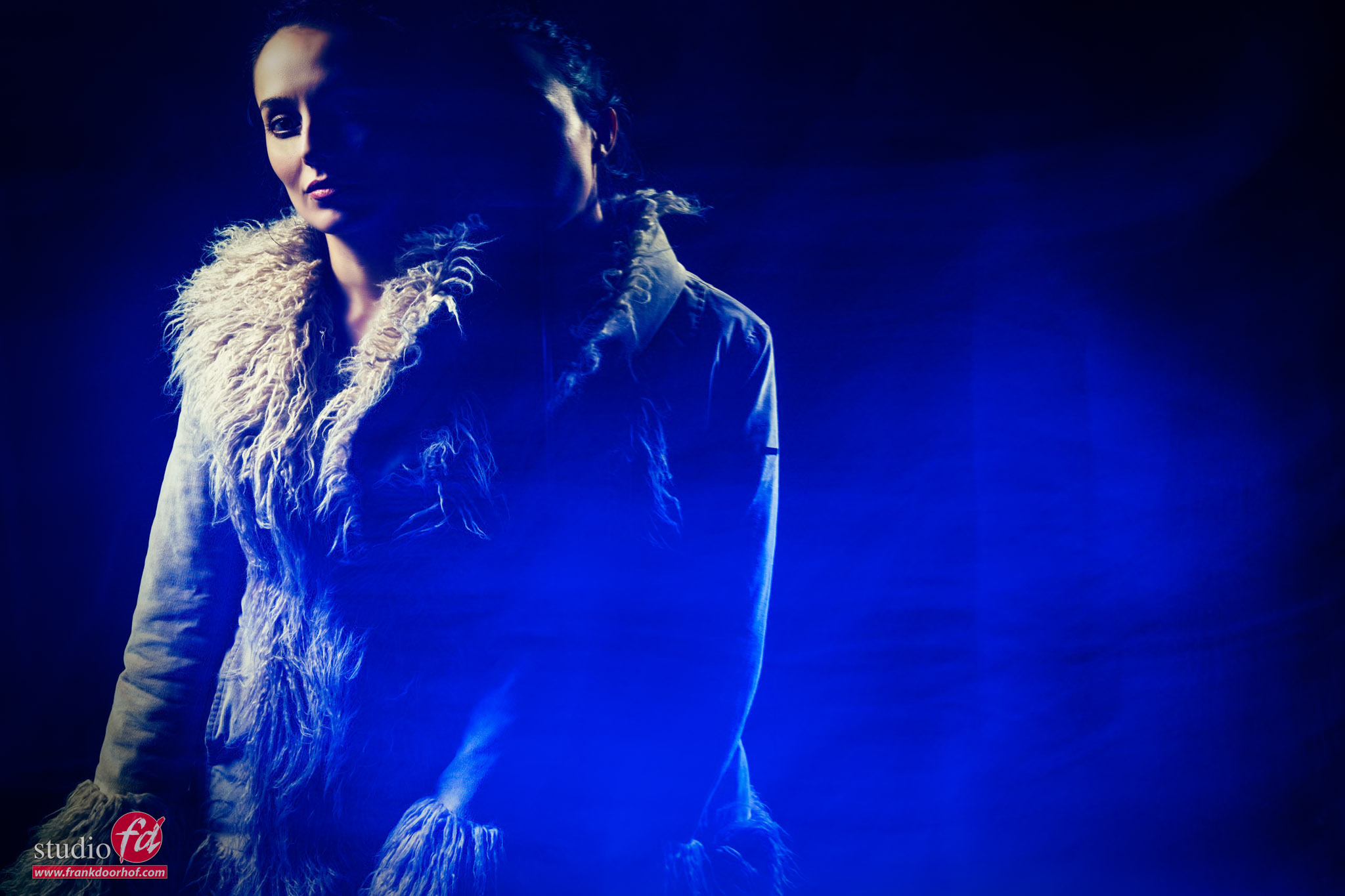
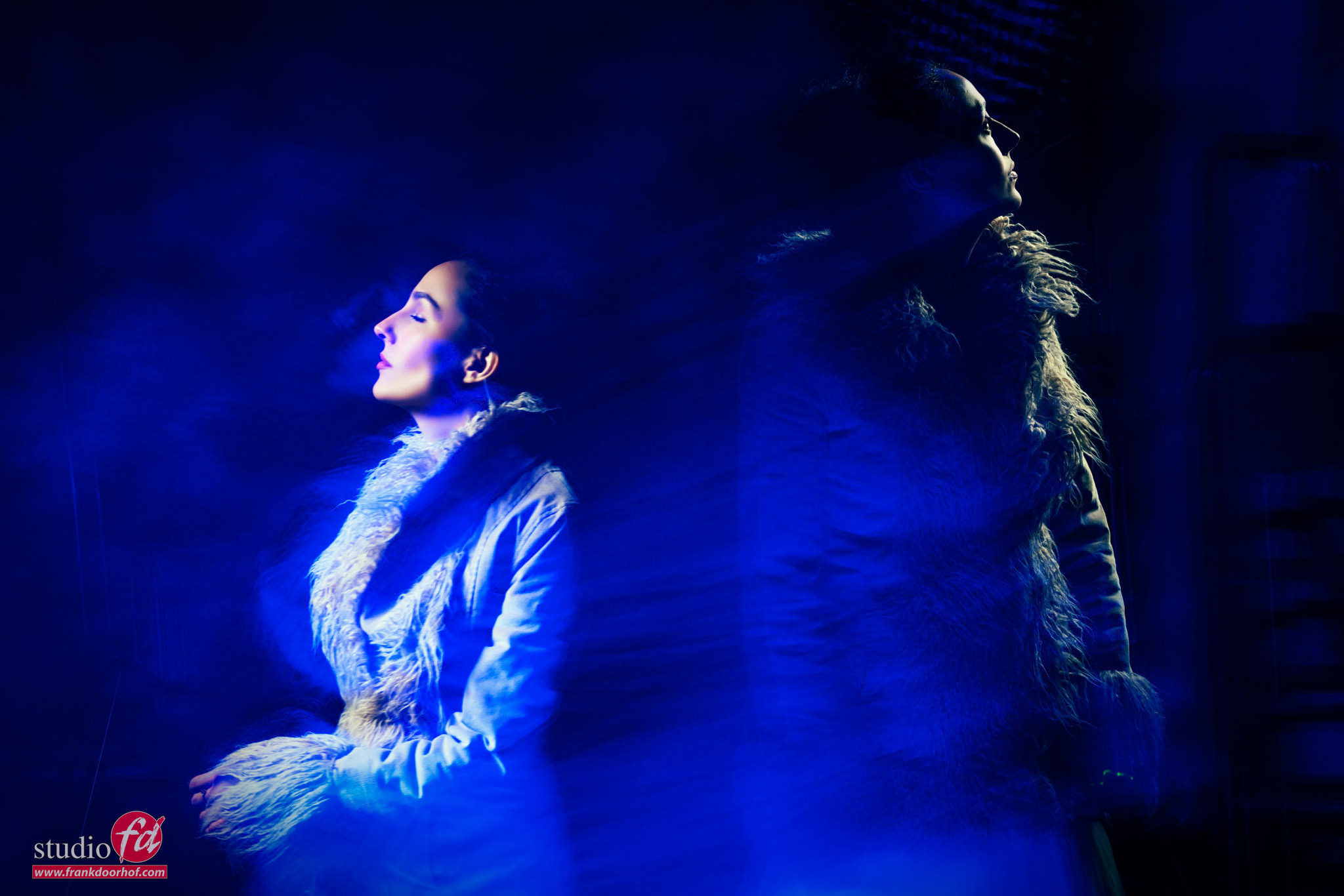
So let’s take a look at two of the results I got during the workshop.
Do remind I’m only shooting a few shots.
Conclusion

Freezing motion is always fun.
But adding continuous lighting and an extra strobe can really push your creativity.
This is a HIGHY addictive lighting setup so don’t blame me if you get stuck in your studio for days trying to get perfect shots. I’m still hunting for that one 😀

Workshops about (mixing) lights

Want to learn everything about light control?
Want to visit a workshop where it’s not just shooting a model with a fixed lighting setup, but see how the setup is built and adjusted to the taste of the group?
And of course learn how to work with poses, backgrounds, small sets, styling, retouching, and a lot more…..

If this all sounds awesome, visit fotografie-workshops.nl and book your workshop.
If you don’t speak Dutch, no problem, let us know a few weeks in advance, and we can switch the workshop to English.
Not possible to travel to the Netherlands?
We got you covered with our 1:1 online workshop.
We have a full streaming setup in our studio. 4 detail cameras and of course the retouching software, so you can see every detail and of course ask questions during the day. Plus, you get all the RAW files after the workshop.
Movement in a different way

Freezing motion is awesome

But it doesn’t stop (pun intended) with just freezing a jumping model of course.
Let’s first take a look at what actually happens when we freeze motion in the studio.

First of all we have to work with something called the X-sync.
When we look back at the old ages it’s easier to understand how X-sync works.
When we take a photo the mirror flips up (not anymore on most cameras), the first shutter curtain opens and is followed by the second shuttercurtain.
With continuous lighting this is no problem, we can shoot as fast as we want and the sensor is nicely and evenly lit.
However when we compare continuous lighting with flash there is a huge difference.

Continuous lighting, is like the name suggest, light that build up over time. The longer you leave the shutter open, the more light will accumulate and the brighter the picture will become.
If we talk about flash something else happens.

Let’s say that for f11 we need 2 seconds of shutter time with continuous light.
When we switch to strobe the f11 is reached within a fraction of a second, it’s one huge pulse of light and that’s it.
But this is where we have a problem.
Not all strobes are the same.

Some strobes will need a longer time to reach this f11 than other strobes.
And to make it even more complicated it also varies per light output. In other words a strobe on the lowest setting wil in most cases be “faster” than on full power.

A quick tip:
To test the speed of your strobes, take a normal fan and shoot it on different settings on your strobe.
In Lightroom check which of the images is the sharpest and you know on which setting the strobe is fastest.
Or get a high end lightmeter like the Sekonic 858 that can also meter the flash duration. And even shows you the cut off and raise of the strobe.

For a proper “frozen” jump I always try to keep the flash duration above 1/2000 of a second.
For the Geekoto strobes I use this means shooting at app 70% of the lightoutput or lower for the best usable stopping power.

But I promised there was more

You probably heard about light painting?
With light painting we have a pitch dark area and a subject that is lit with continuous lighting but not in a normal way, we literally paint the light in.
Compare it a but with dodge and burning in the darkroom/photoshop.
it’s a great technique.

and of course it’s possible to combine the two in one shot.
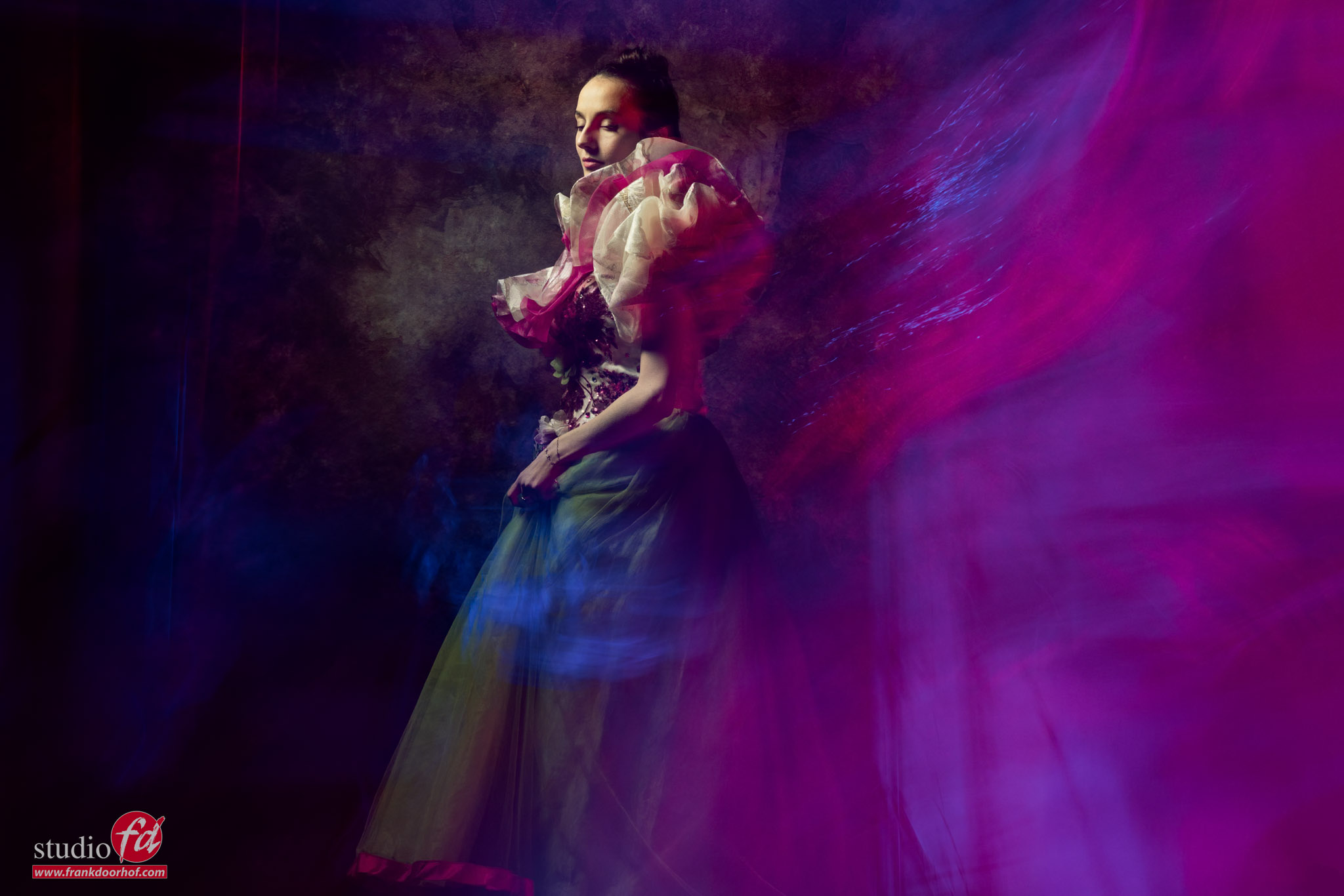
What about first freezing the model with a strobe and than leaving the shutter open for another light source?

That’s exactly what we did here.

I’m using one strobe (without the modeling light of course) on the model from the side.
I use a small softbox here like the Geekoto Quicky or S26 with a grid, to make sure I only light the area I want to be “strobed”
After that the rest of the scene is filled in with a led tube in this case.

I’m using a Nanlite Pavo tube in “cop mode” where it alternates between red and blue.

We do have a few problems.
When you would just keep the camera on a tripod, fire the strobe and start adding the led tube you will quickly find out also the face is “infected” with the light of the led.
This is of course not something we always want.

So to make sure you have total control and can do some really funky/creative stuff it’s best to make sure you hand hold the camera.
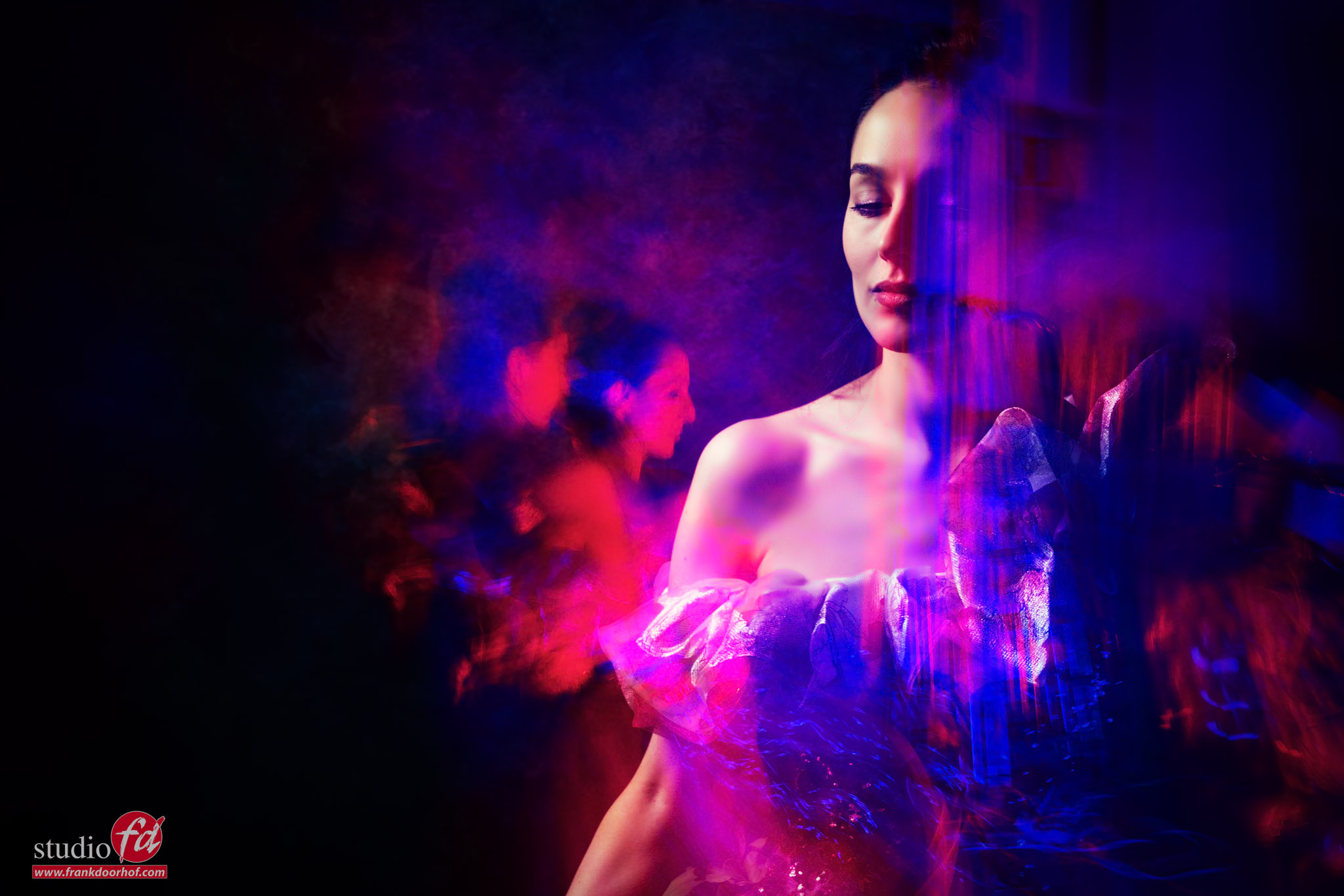
Now make sure your composition is as you want before the strobe fires, as soon as the strobe fires, LOWER your camera to the point that the face of the model is outside of the frame, this way it can’t be lit by the leds anymore so now you have free range with the led. To make it even more interesting while the led tube is moving you can tilt your camera, zoom in or zoom out, what ever you like.

The funny/bad thing is, that whatever you do it’s impossible to recreate exactly the same effect.
That’s makes this incredibly fun to do, but also sometimes frustrating because no matter how well you master your craft, this is always a gamble.

During the workshops I only take a few shots, but I’m sure when you spend longer you will get much better results.
For a workshop I’m really happy with these results with our model Malin.
In the next blog post I’m talking about using a second strobe.

Workshops about (mixing) lights

Want to learn everything about light control?
Want to visit a workshop where it’s not just shooting a model with a fixed lighting setup, but see how the setup is built and adjusted to the taste of the group?
And of course learn how to work with poses, backgrounds, small sets, styling, retouching, and a lot more…..

If this all sounds awesome, visit fotografie-workshops.nl and book your workshop.
If you don’t speak Dutch, no problem, let us know a few weeks in advance, and we can switch the workshop to English.
Not possible to travel to the Netherlands?
We got you covered with our 1:1 online workshop.
We have a full streaming setup in our studio. 4 detail cameras and of course the retouching software, so you can see every detail and of course ask questions during the day. Plus, you get all the RAW files after the workshop.
The problem with a global shutter that a lot of people will miss

Yes, Sony revolutionised the photography market

Without any doubt one of the biggest steps forward has been released by Sony, and it’s called the A9III
But why is it this huge step forward?

One might think that when we talk about huge steps we talk about MegaPixels, ISO etc. But this is all just adding to something we already have. When I talk about a huge step forward I of course mean the new Global Shutter.

Global shutter?

So why is this global shutter thing such a big deal?
When you work with strobes you probably know that the term X-sync.
The X-sync is the maximum shutter speed you can can use without seeing an annoying black bar due to the second shutter curtain.
For most cameras with studio strobes if you stay at or below 1/125 you will have no problems at all, and in the studio this is actually no limit. Most studios are dark so the slower 1/125 shutterspeed is no problem.

However when we go outside things change.
When we work with strobes we now have to compete with the ambient light.
Take into account the limit of 1/125 and you quickly understand why a lot of those shots with loads of strobe power have a DOF from here to eternity 😀
In other words, outside we often have to shoot at f22 to get the balance we need due to that 1/125 limit.

Solutions

Luckily there are solutions.

  1. Make sure you don’t place your subject close to the top. This way you can shoot at 1/160 and sometimes a bit higher without noticing the black bar. It’s still there for the strobe but the ambient light will not show it and the subject is somewhere in the middle so it will still get the strobe. A quick fix but far from perfect due to the huge limitation for composition (but it’s a nice one if you have to and can for example crop later in Photoshop).
  2. A bit more serious are solutions like HSS, HS
    With HSS your strobe fires a lot of flashes during the exposure making sure the sensor is always lit by the strobe. This eats both power from the strobe but also from your batteries, it’s also a system that’s not 100% stable in output and can overheat a strobe pretty fast.
    HS is a system that uses the cut off and raise of the strobe, not to make it too difficult it uses a very slow strobe to get faster shutter speeds, same issue here is that it eats power.
  3. It doesn’t help with the shutterspeed but you can use ND filters to get a shallow DOF, although this can work great there are some disadvantages, first of all a good ND filter for use with strobes will be a pretty strong one, or a variable (I have the KF concept in my kit and really like that one) And with the stronger ND filters you will get into some problems with focussing speed. Also some ND filters will give you a light drop off in the corners.
  4. Leaf shutter lenses
    Leaf shutter lenses are awesome but expensive.
    The shutter is inside the lens and this means it breaks the limit of 1/125 with ease, there is still a limit (for example 1/1500) which in most cases however is more than enough, especially because most of these lenses are found in the Medium Format cameras.
  5. Cheap cameras
    Believe it or not but years ago I shot with a very affordable small Fuji camera which was able to shoot up to 1/1000 with strobes. This was a far cry from a professional camera, but I decided to include it to make the list complete.

So what’s the big deal with a global shutter?

In short….
There is no real limit anymore.
You would be able to shoot strobes up to 1/16000 or even 1/80000 when using Sony compatible strobes.
Sounds awesome right?
And it is, but there is one limit I have to tell you about that will prevent some nasty surprises.

The speed is important

The idea of shooting at 1/16000 will excite a lot of photographer but it could also be a huge disappointment, but that last part can be solved with a bit of technical information.

When we use our camera we all know that the shutterspeed will determine the “freezing power” of your camera.
The faster the shutterspeed the more action is frozen.
When we use strobes we often just look at the output. And in the past this is 100% understandable, most strobes are fast enough to freeze motion in the studio so we often don’t link shutter speeds to flash durations.

When we look at the specs of our strobes we do however see a value that links the two.
The t0.1 and t0.5 values. You might notice that those values are often mentioned in a range from very fast to slower,
Maybe you also found out that the way the motion is captured does vary depending on the power output of your strobes, especially with cheaper strobes it’s very possible that there are only a few power settings that will freeze the motion, where with the others there always is a slight blur.

When I look at the strobes I’ve worked with over the years there were strobes that topped out at 1/1000 and 1/60000.
As you can see this is a huge difference.
So what is the link with a global shutter?

Let’s shoot a mountain biker at 1/16000 with our strobe on full power.
Now let’s shoot the same mountain biker at 1/16000 with our strobe at 75% power.
I can almost predict that the 75% setting will be brighter.

So what’s going on?

You can shoot with the shutterspeed at 1/16000 and there will be no black bar in the frame, however the strobe has to be just as fast as the shutterspeed otherwise the shutterspeed will be cutting off the power of the strobe while it stills flashes.

This is very difficult to visualize because our eyes can’t see how fast a strobe fires, so we need a special tool for this.
To measure the flashduration of my strobes I’m using the Sekonic 858 lightmeter.
When I measure my Geekoto strobes I can clearly see that they are incredibly fast in the lower settings, as soon as I pass half power they are still fast enough to freeze any motion (1/5000+) but when I reach full power the flashduration gets a serious hit. Now this has nothing to do with the Geekoto strobes, but it’s all strobes and brands, it’s simply how it works.

So how does this fit in the global shutter story.
When you read the reviews and specs on the A9III you might expect that your strobe will behave the same as in the studio and this can lead to not getting the maximum performance out of your brand new camera.

The best way to make sure you get the maximum out of your system is to shoot a series of images on a white wall with the camera on a tripod. Don’t change anything on the camera itself but only change the output of the strobe. Do this for several shutter speeds and watch where the strobe starts to get dimmer and put a sticker on the strobe with those settings.

Why is this important?

When you use a lightmeter on location the meter has “no limits”, so it will give you the value of the full strobe, if the strobe has a flash duration of 1/800 or 1/16000 it doesn’t matter for the meter. Now that we know that the shutterspeed of the camera can cut off the strobe it’s also clear that when we are shooting above the “speed limit” of the strobe the value on the meter will not correspond with what you get in your photo.

Besides the trick with the white wall there is a solution for this, but it’s not cheap, but it will make it much easier.
When you use the Sekonic 858 there is a setting that doesn’t just meters the light but also the flashduration. This can be a very useful tool where you can not only find the setting with the fastest flashduration, but also to know how fast you can set your cameras shutterspeed.

A feature that was handy for reviews in the past has now become an essential tool to use your flash system to the max, and that’s a good thing, a really good thing. We can do amazing things with global shutters and flash, can’t wait to test it out myself.


To be clear, I have not shot with the A9III, this why there are no examples (I don’t fake examples), the technique however is universal.
Use the links on our site when ordering from Amazon and you support our work.