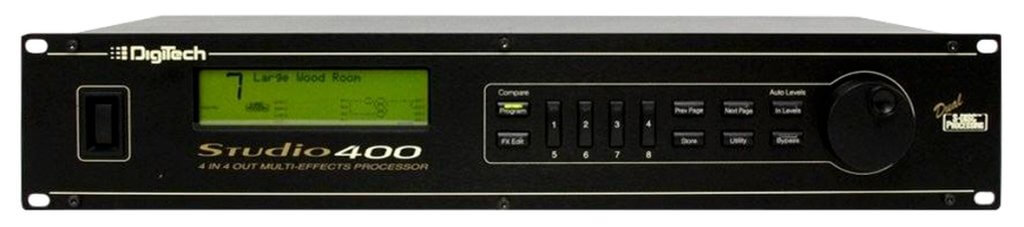
A very nice allround studio box
When I started with building our home studio the idea was to do everything in the box.
That quickly changed to using a mixer, which became a vintage Yamaha 01v96.
The Yamaha sounded ok but I especially loved the fact that you could store the settings.
When you work ITB (In the Box) it’s easy to save your projects, however when working with a console you do a lot of the settings on the console so being able to recall this later on is a big plus.
The only problem was the software, at one point I grew tired of using a Windows interface under Mac to get the Yamaha to work.
And when the software became more unstable I looked for something else, which eventually became the X32, that I still use and can highly recommend for home studios.
When I worked in our studio in my 20s we didn’t have a lot of outboard gear, the compressors were in the channel strip and I believe we had 1-2 reverb boxes which you could just mix over all channels, it was more than enough at that time.
When I got the X32 I found myself leaning towards the effects in the X32 vs the plugins, don’t get me wrong plugins can sound great, and in essence in the X32 it’s also a digital plugin, but it just feels different to have it under your fingers on a console.
Because the X32 also had inserts I wanted to connect at least one good studio grade unit. (this is how an addiction starts).
When I saw a Digitech S400 online I could not resist.
It’s often described as the poor mans Eventide so it had to be awesome right…..
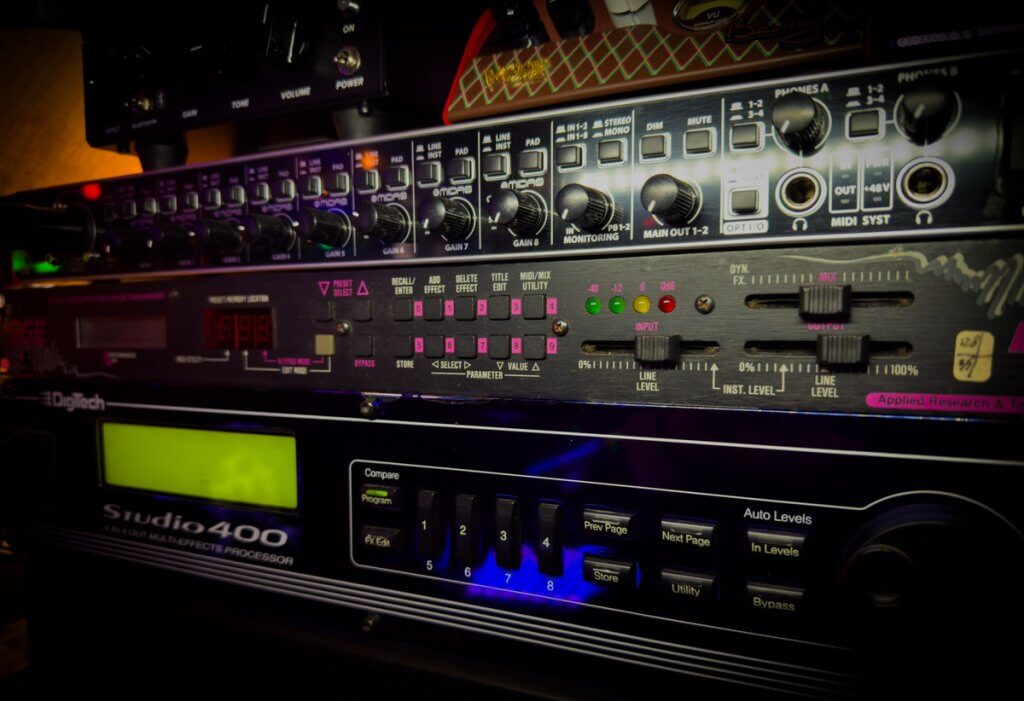
And it is.
You might wonder when you see a rack, “why all those different units, when you can get it in plugins or one box that does it all?”.
And that’s the thing. They all sound different, they have different options, and especially the analogue effect units have a unique sound due to the fact that analogue gear always slightly fluctuates so it’s always slightly different (well at least that’s what I’m told by experts)
Funny detail is that you see a lot of people creating IRs from old vintage rack gear for the modern modelers.
Although I think an AxeFX is awesome and would love to own one, the price and future proofing however makes me prefer the rack gear. In fact my whole rack is cheaper than the latest Axe FX 😀
The interfaces are much more basic and if you’re lucky you can get software to upload and download settings, sometimes even live adjust, but that’s about it. However they all can also be controlled from the front panel, making them 100% future proof. And the sound….. well there is a reason they create IR’s from them. But a lot of the effects are impossible to capture with standard IRs, maybe in the future, but for now all the real chorus, reverbs etc. are very hard to capture 100% accurately.
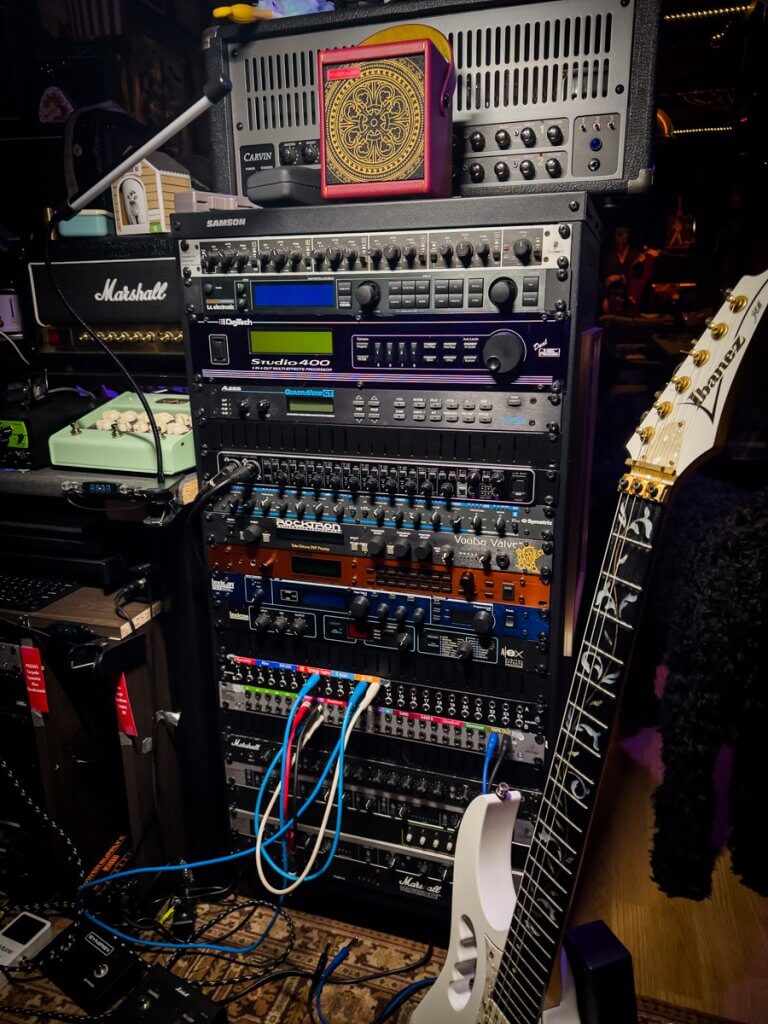
It’s like pedals
A reverb is not a reverb and there is the fun of old rack gear.
When I compare the Lexicon to the Digitech there is a very distinct difference, which makes it so much fun to collect these older rack units. And as mentioned before, the price is often very low and if you are into the creative workflows, there is always something you can do with a unit and create something that is different from all the new stuff.
Let’s take a look at the Digitech S400
When I look at my rack at the moment all the FX units have their own “personality”.
The 2101 for example is for the most extreme and mind boggling combinations of FX, the G-Major is that awesome unit that will do it all but doesn’t go into overkill mode. The Lexicon reverb is great on drums and everything else in fact, so where does the S400 fit.
The S400 can do pretty complex things, including a harmonic harmonizer that sounds very nice. Also the Detune is one of the best I have in my rack. For me it doesn’t stand out in anything, but it combines the elements of almost all units and gives it all in a 4 channel unit. None of the effects is the best I have, but the combination and quality of all the FX together makes the S400 the perfect rack FX unit if you want to start your journey.
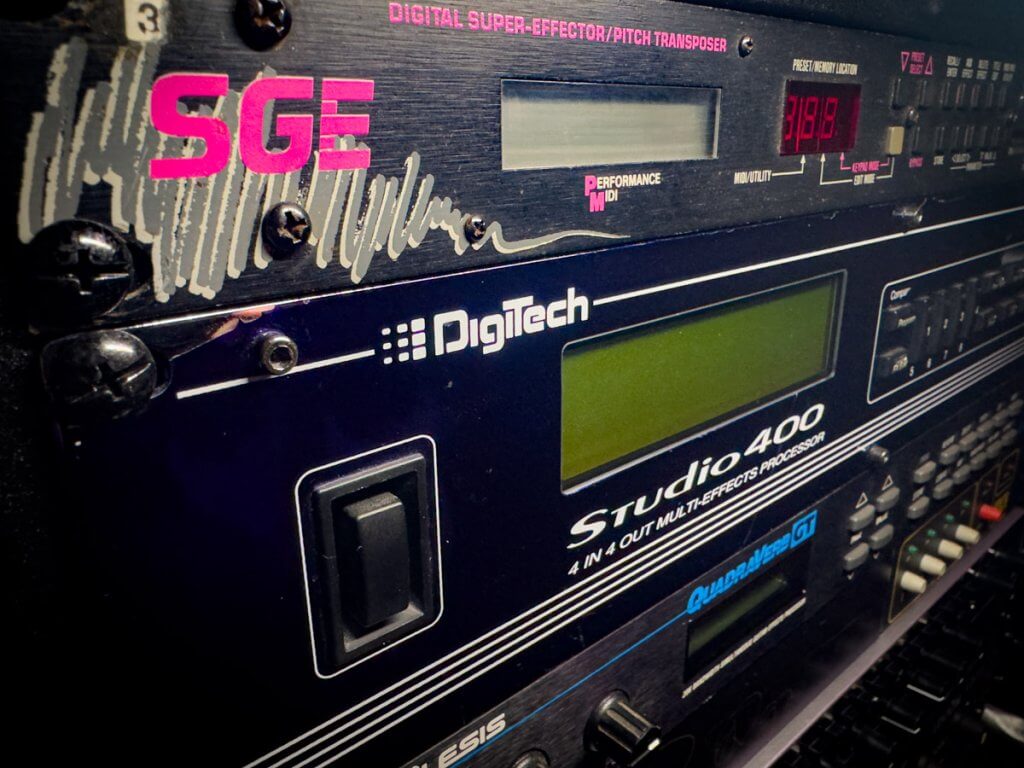
The following is a combination of what I found on the web, some Ai and myself.
The DigiTech Studio S400 is one of those rack effects processors of the 1990s you see popping up on second hand sites.
The S400 was released in a time when hardware multi-effects units dominated professional and project studios, the S400 stood out thanks to its dual-DSP architecture, flexible routing options, and impressive collection of reverbs, delays, modulation effects, pitch shifting, and harmonization algorithms. Even today, it remains a surprisingly capable processor for producers looking to add character and hands-on workflow to a DAW-based studio.
I’m using the S400 in logic with the I/O utility.
Mostly I use the S400 on a bus so I can add the amount of the FX I want on different channels.
You can however also use the S400 as an insert and mix the direct and wet signal inside the S400 it’s very flexible and can be used for both studio work and in a guitar rack.
One of the S400’s greatest strengths is its modular design. The processor allows effects to be configured in different combinations, making it possible to build complex signal chains with multiple effects running simultaneously. You can combine chorus, delay, reverb, pitch shifting, EQ, compression, and modulation effects in creative ways that were considered highly advanced for its era. The unit’s four-input/four-output architecture also makes it useful for processing multiple sources at once.
In a modern home studio, the S400 works particularly well as an external effects processor connected to a DAW through an audio interface. By routing audio from your DAW through dedicated outputs and back into spare inputs, the S400 can be used exactly like an outboard effects rack. This approach is especially effective for synths, drum machines, vocals, and guitars, allowing you to capture hardware effects directly into your project. The reverbs and modulation effects have a distinctly 1990s digital character that can help tracks stand out from today’s often-polished software plug-ins.
Many users continue to praise the S400 for its lush choruses, rotary speaker simulations, intelligent harmonizers, delays, and spacious reverbs. The unit’s ability to create wide stereo textures makes it particularly attractive for ambient music, synthwave, electronic production, and experimental sound design. Some enthusiasts even compare its flexibility to more expensive processors such as the Ensoniq DP/4, earning it a reputation as a budget-friendly secret weapon.
Although the Studio S400 itself was never marketed around celebrity endorsements, DigiTech’s rack processors and effects have long been used by respected artists across rock, progressive music, and studio production. Artists associated with DigiTech products include Steve Vai, Adrian Belew, Peter Frampton, Vernon Reid, and others, helping establish the company’s reputation for innovative digital effects.
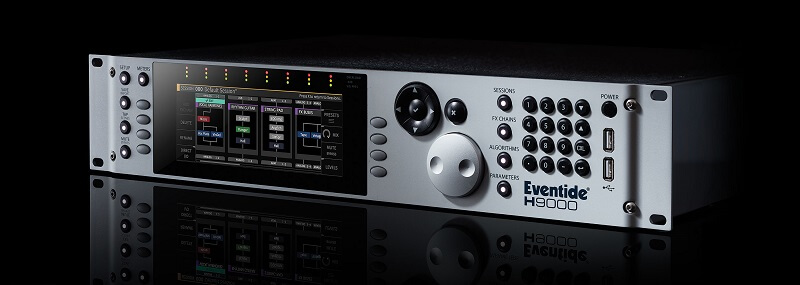
S400 vs. Eventide Harmonizer
The DigiTech Studio S400 and the classic Eventide Harmonizers occupy similar territory but target different users. The Eventide units are renowned for their world-class pitch shifting, harmonization, and studio-grade effects quality. They offer more refined algorithms, deeper editing, and the unmistakable Eventide sound heard on countless professional recordings. For me the Eventide is like the holy grail for studio/guitar work, and remember Vai using them in a very creative way and from that moment on I was sold on detune for chorus FX and making the guitars wider, however at that time there was no way I could ever afford anything that would make that possibe. When I bought the VG88 I got a lot of options that came close, but they just didn’t sound as lush and wide as the Eventide (probably also great studio work with the mastering :D).
And even today, an Eventide doesn’t make sense for a hobbyist it’s still very expensive, for me it doesn’t make sense spending several thousands on an FX unit for hobby purposes if there are great plugins and alternatives.
The DigiTech S400, however, is significantly more affordable on the used market and offers exceptional value. While its harmonization and pitch effects are not as sophisticated as an Eventide, it excels as a versatile multi-effects processor with excellent modulation effects, creative routing options, and a distinctive vintage digital character. If you need the ultimate harmonizer, Eventide remains the benchmark. If you want a powerful rack processor that delivers a wide palette of effects for a fraction of the price, the DigiTech Studio S400 remains one of the best bargains in vintage studio hardware.
I hope you enjoyed my overview of the Digitech S400
I’m always open for additions, so feel free to reach out.