Two legendary guitars: The Ibanez JEM777VBK and JEM7VWH Ebony
When I grew up it was the 80s (1971) and the best time for guitar lovers of course.
I always loved Queen, but I very soon found that my musical taste was drifting towards the more technical site of guitar orientated music.
Bands like Dream Theater, Cacophony, Malmsteen, Van Halen were standard listening material.
It wasn’t all technical, I also love bands like Metallica, Def Leppard, Poison (yeah ok, remember the 80s), Steelheart etc. I could go on and on.
And than the moment you hear about a guitar player you had to check out, his name… Steve Vai.
You know those moments where you just want to give up playing guitar, but also want to grab the thing because you want to master that riff. That was Vai for me.
There was no internet, so all the information in The Netherlands came from American Magazines mostly, and CD’s/LP’s (vinyl). I heard Flexible and was blown away, this was not guitar playing this was EVIL….. and I LOVED it.
When Passion and Warfare was released I was already deep into Vai, Satriani and loads of other technical players. And even than it was already clear which ones would have a long future. Loads of the shredders become boring very fast, but Vai and Satriani always had something special for me, although I would have loved to see what Jason Becker would be able to grow into if he would have not been forced to stop his career at such a young age. His work with Marty Friedman was scary and insane.
I remember my first concert in a stadium.
Of course I went for Poison, but was also very curious about Whitesnake and Aerosmith.
And you know those moments that are life changing?
Well this was one.
This was the lineup where we could of course see our Dutch pride Adrian VanDenBerg but also the “hired gun” Steve Vai. Remember that at that time we had no Internet so I was not really prepared for the stage presence of Whitesnake. Coverdale is an awesome singer but seeing Adrian and Vai playing together was awesome. The moment the lights went off and Vai clicked a three neck heart shaped guitar on a chain and while it had the perfect feedback it was lifted up lighting the whole stadium like a mirror ball. I was sold.
As a guitarist signature series can be great, and when I saw the flower jem in a local music store I could only dream about one day owning one. That day came a few decades later.
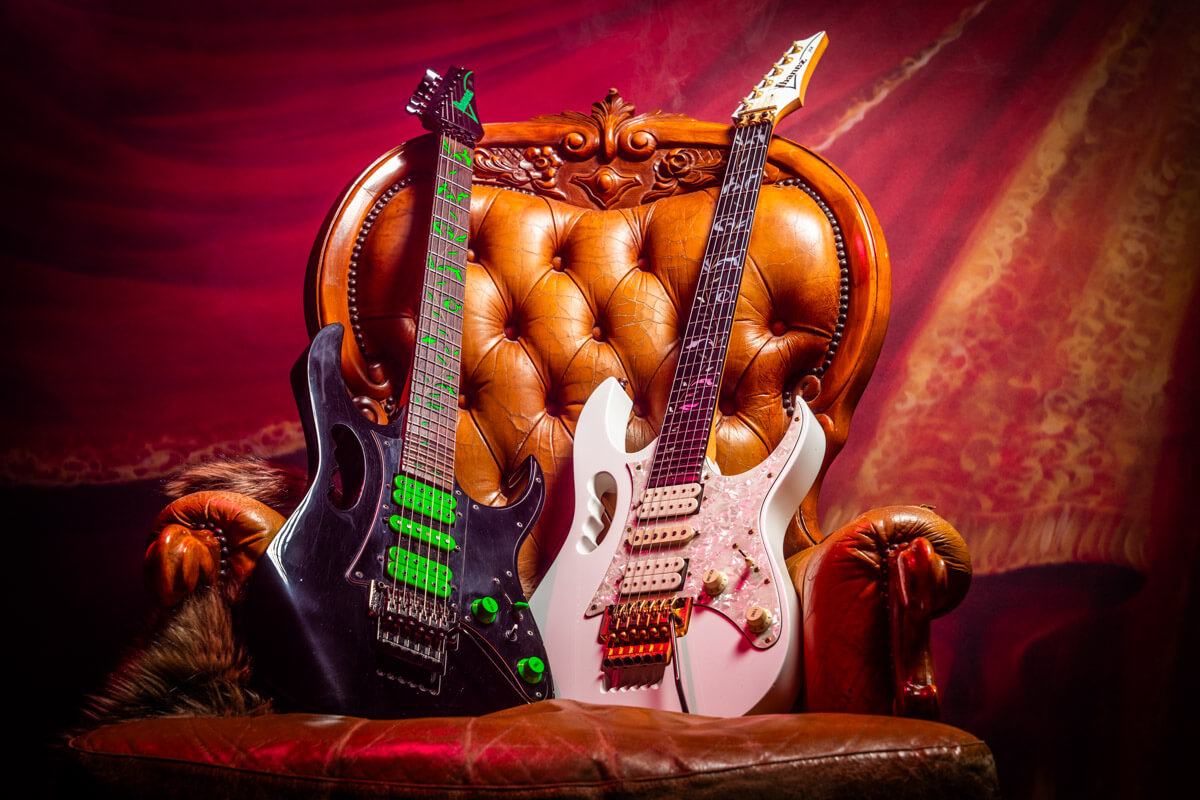
The two jems
When I started playing guitar again after a 15+ year pauze I still owned some guitars including a great Hamer Centaur USA, but I knew what I wanted…. A Jem.
With a bit of luck I was able to buy a very nice Jem 777 VBK, the previous owner build in a booster which was not working any more and the frets needed some work. Luckily I know a great Luthier and a few days later I had my first Jem.
I was not planning on getting another one, prices were pretty high and the 777 VBK was my favorite guitar. But when you can get a great deal…. there is always room for one more right? 😀
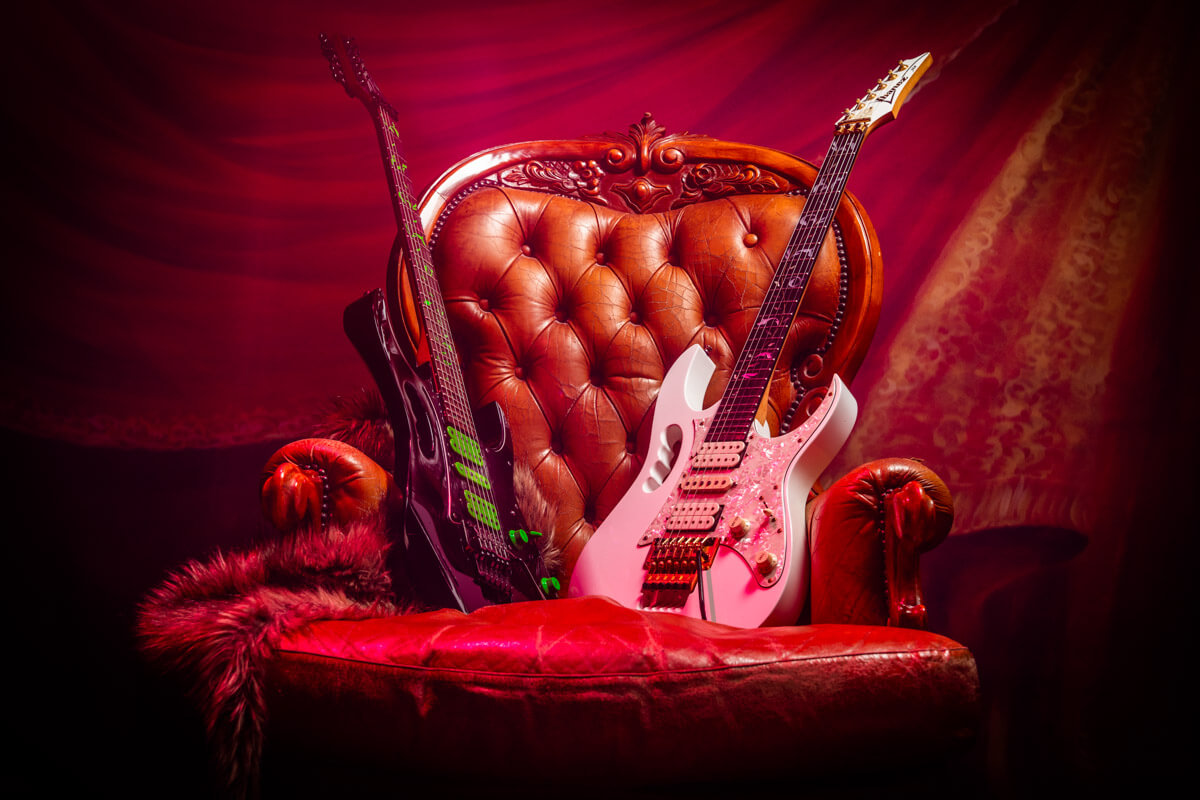
When I saw the add for a Jem 7V WH ebony I could not resist, and although it was not really planned I had a very unique duo. Literally the dark and light side of Vai.
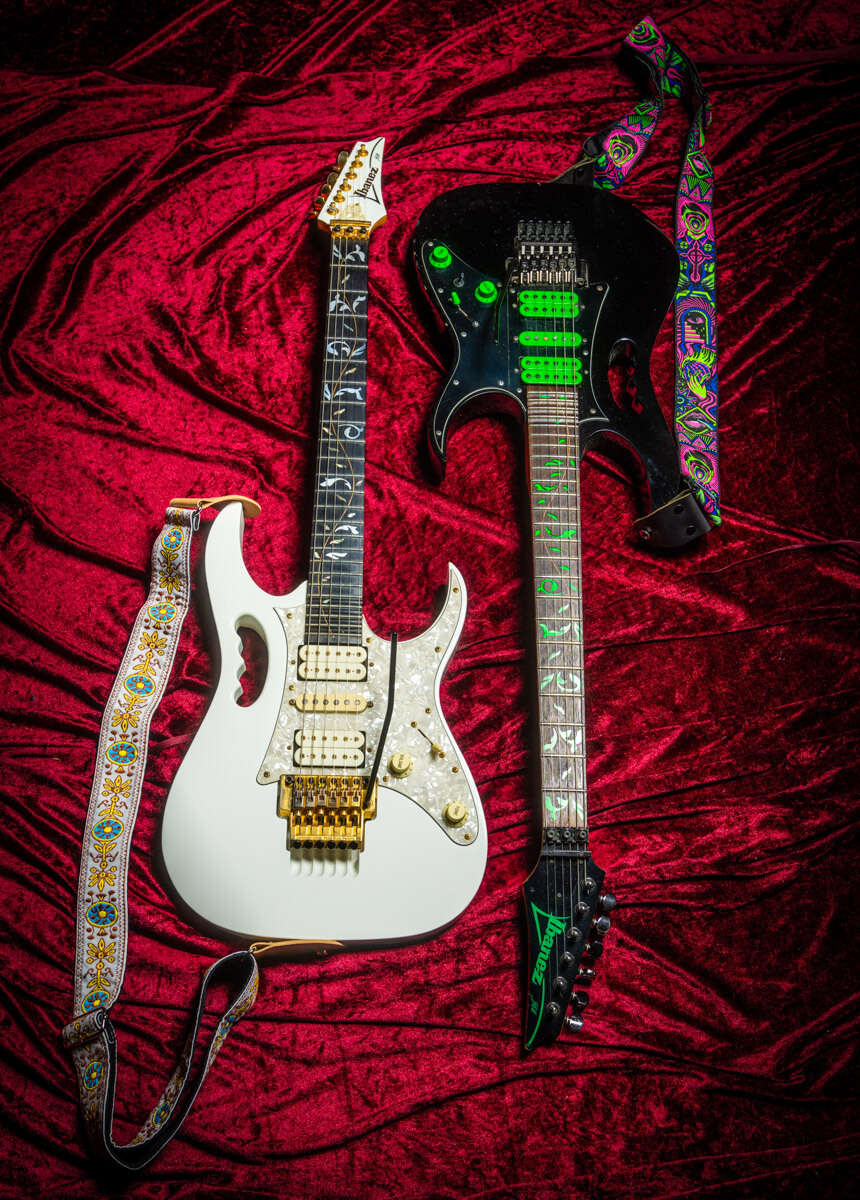
Let’s take a look at the history of the two jems
Few guitarists have influenced electric guitar design as much as Steve Vai.
He saw the perfect guitar and made sure it was build exactly like he wanted, and eventually Ibanez got it right, and he is still with them and the Jems are still sold. But also the RG series was inspired by the Vai improvements and was sold as a budget friendly version of the Jem, but some of them have grown into their own legends, like the RG550. A few years ago Ibanez and Vai updated the Jem with a new guitar the Pia.
But the Jem was the real technical breakthrough.
The lions claw for a floating trem, the monkey grip, unique switching combinations, scalloped high frets, 24 frets etc. the Jem was a landmark in guitar design. And even when you play the older Jems there is nothing to wish for, they just work and sound great.
The two Jems I own myself are I think a great contrast in the history of the early Jems.
The Jem 777VBK and the early JEM7VWH with its ebony fingerboard are separated by only a few years, but they represent a totally different era of the development of the Jem and Steve Vai’s tone journey.
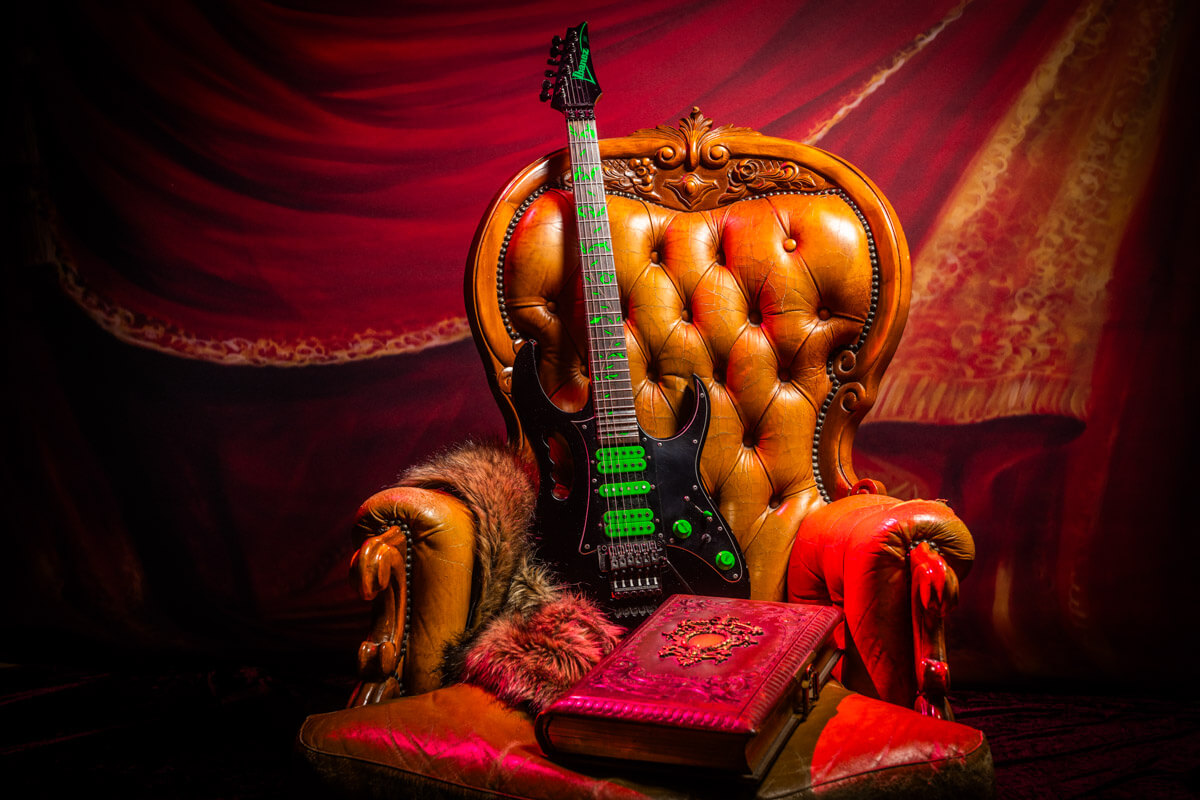
The Jem777VBK: The Last of the Original Era
Introduced in 1988, the Jjem 777VBK was a darker, more toned down variation of the original Jem777 series. Where the previous series had bold colors like the now famous and very sought after Lochness green, Shocking pink, and Desert yellow models featured maple fingerboards with disappearing pyramid inlays, the VBK introduced the now famous tree of life inlay on a rosewood fingerboard. It was also the first black Jem, giving the guitar a more elegant and aggressive appearance.
The guitar featured:
- American basswood body
- One piece maple neck
- Rosewood fingerboard
- Tree of Life inlay
- DiMarzio PAF Pro pickups
- Original Edge tremolo
- Black finish with dark hardware
The Jem 777VBK was clearly aimed and designed for the 1980s shred era. It was designed for speed, technical and very technical playing. And of course some insane tremolo work.
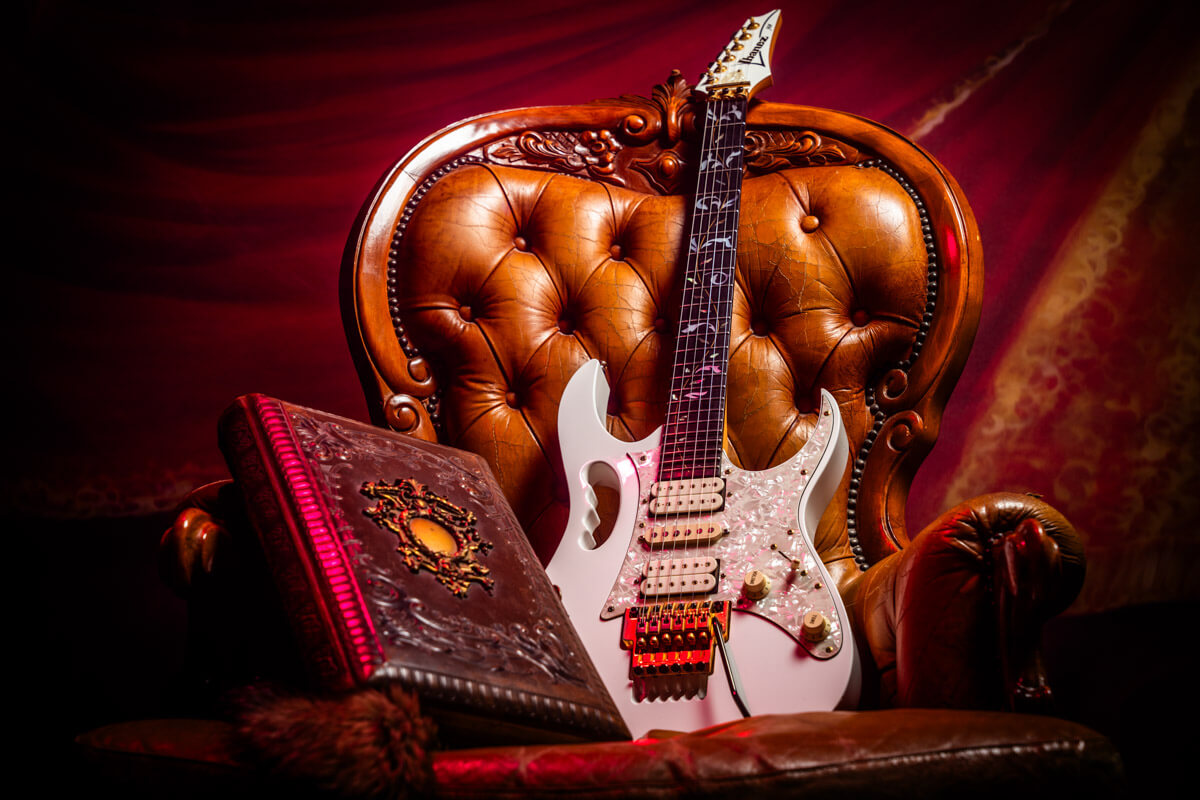
The Jem 7V WH Ebony: this became “EVO”
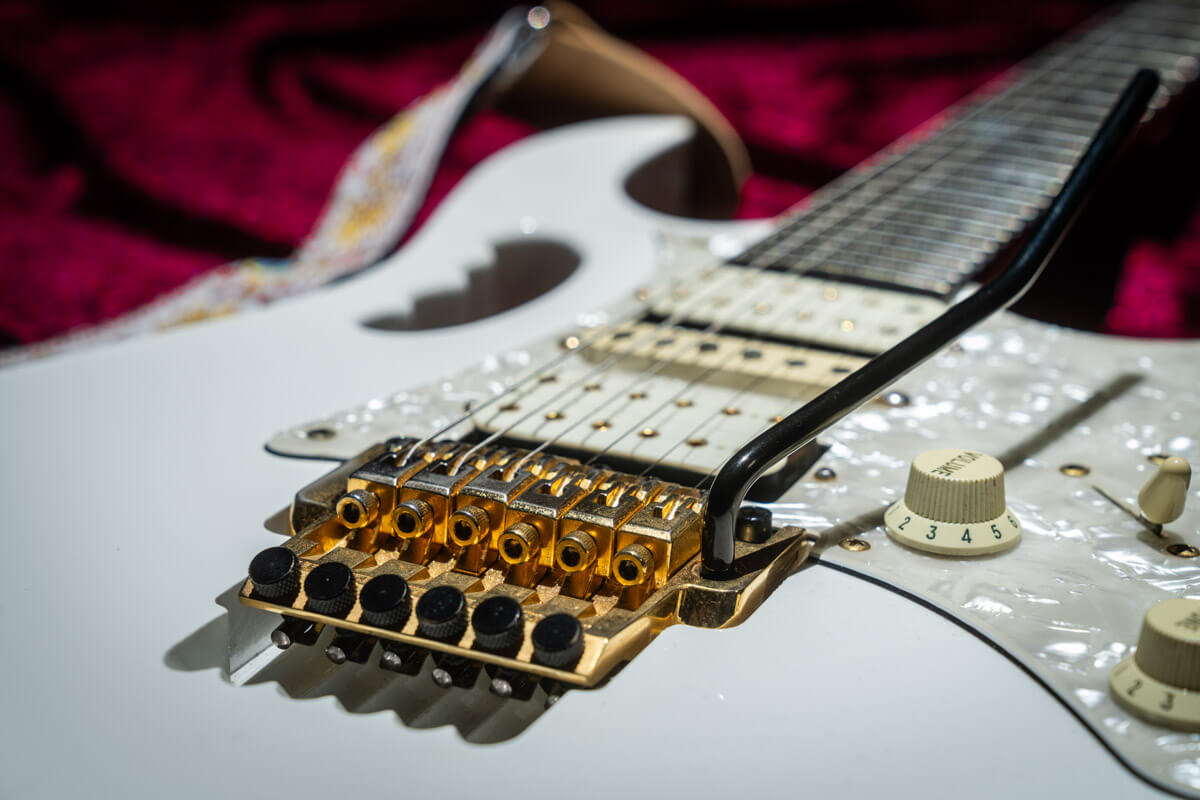
The 7V WH was released in 1993 (also the year of mine), Vai wanted something else at that moment, a more refined instrument with greater tonal power and visual elegance. Which became the 7V WH, or also called the “White Jem.”
This guitar introduced several major changes:
- Alder body instead of basswood
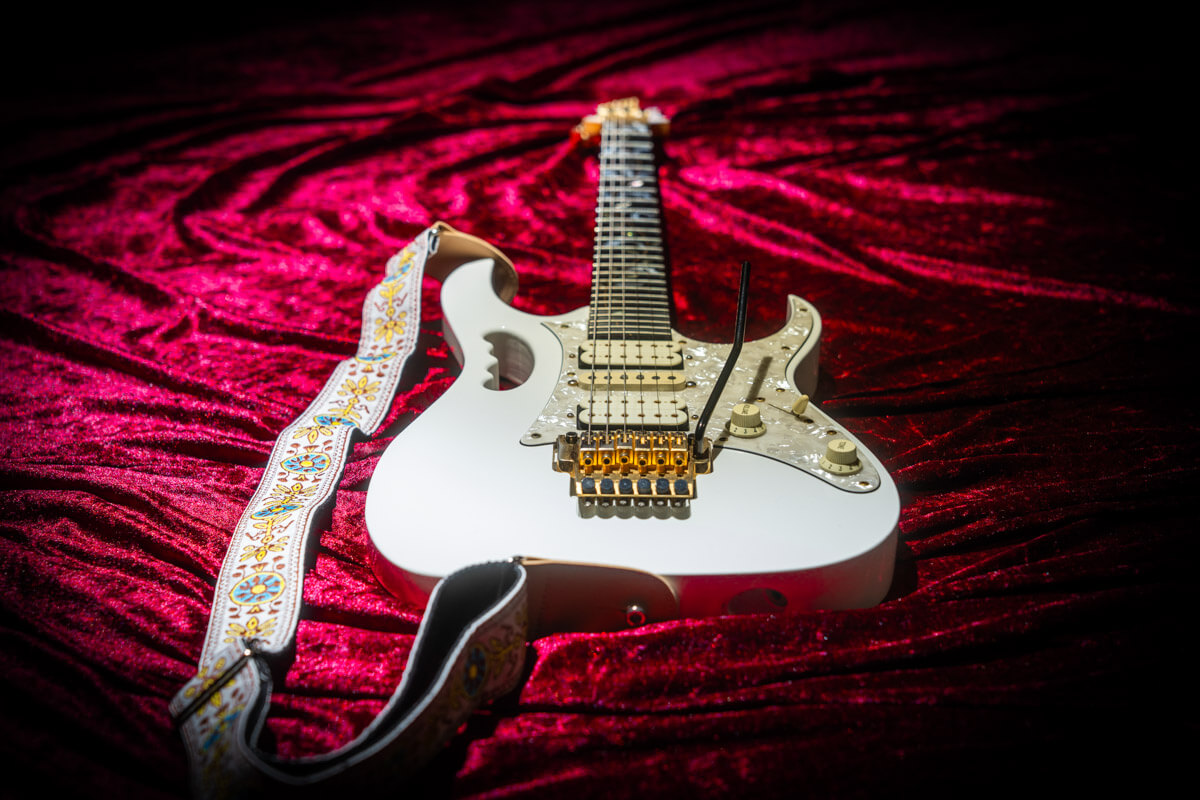
- Ebony fingerboard
- Tree of Life inlay
- Gold hardware
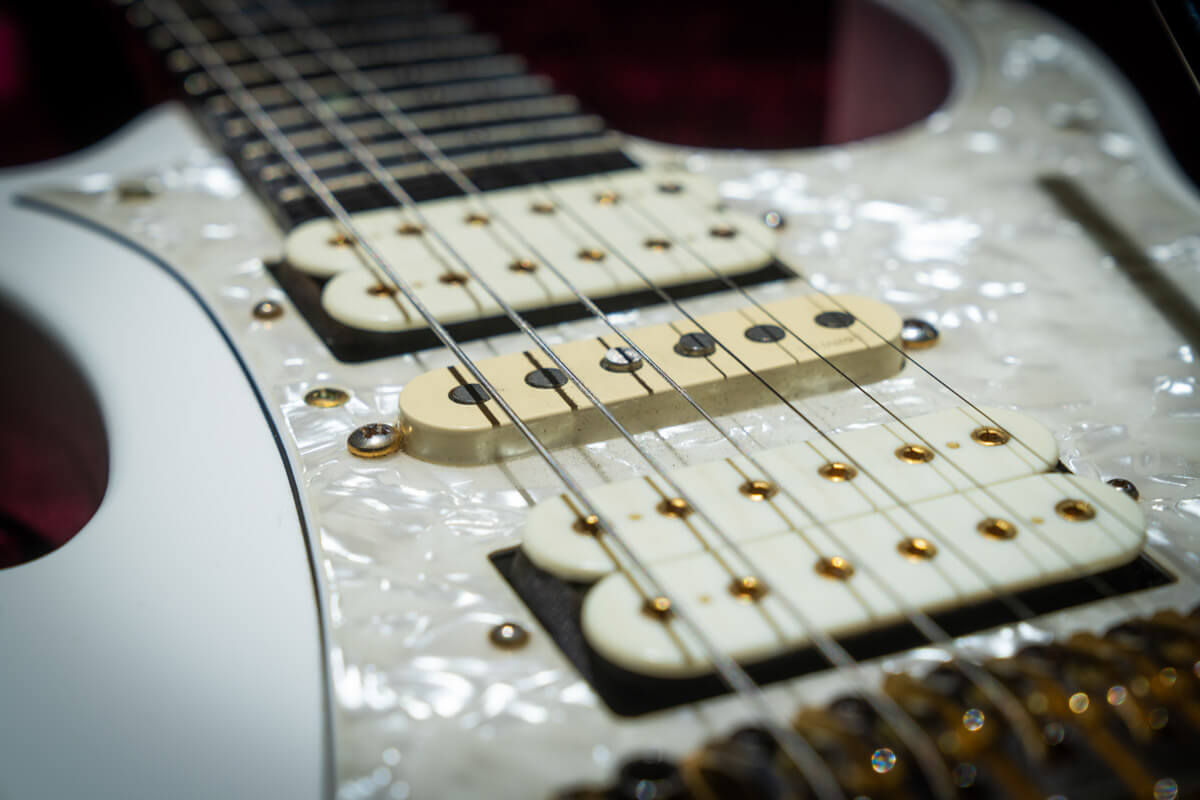
- DiMarzio Evolution pickups
- Lo-Pro Edge tremolo
- Last four frets scalloped
Most importantly, the prototype of this guitar became Vai’s legendary guitar known as “Evo,” arguably the most famous instrument in his collection. The Jem 7V WH was designed around the features that would define Vai’s sound throughout the 1990s and beyond.
Where They Differ
At first glance, both guitars are unmistakably Jems. They share the Monkey Grip, deep cutaways, HSH pickup layout, and floating tremolo system. Yet they feel remarkably different in the hands.
My personal favorite is the 7V WH, it just feels like home every time I pick it up, it’s super aggressive but can also sing, and I always get my tone within a few seconds. The VBK777 is much “sweeter” and is great for warm cleans. Also the feel of both is totally different, the neck of the VKB777 feels great but the 7V WH wins. Of course this is all personal opinion.
Fingerboard
The most obvious difference is the fingerboard.
The Jem 777VBK uses rosewood.
Where the early Jem 7V WH features an ebony fingerboard, which provides a faster, slicker feel and a brighter attack. Many players consider the ebony Jem 7V WH models among the finest production Jems ever built.
Body Wood
The VBK’s basswood body delivers a smooth, balanced response that became synonymous with many late-’80s shred guitars.
The Jem 7V WH moved to alder, giving the guitar a slightly more focused midrange and enhanced note definition. This change reflected Vai’s desire for a broader tonal palette as his music became increasingly sophisticated.
Pickups
The Jem 777VBK was equipped with DiMarzio PAF Pro pickups, which defined Vai’s late-’80s tone. These pickups offered clarity, articulation, and a balanced output. Personally I prefer the Evolutions, but the booster in the 777VBK makes a real difference and also gives the guitar a lot flexibility, so adding a booster to slightly lower output pickups could be an upgrade that also works for you.
The Jem 7V WH introduced the DiMarzio Evolution pickups developed with Vai himself. They provided more output, greater harmonic content, and a sharper attack. The pickup’s name became inseparable from Vai’s famous “Evo” guitar.
Conclusion
Having both the black and white Jems and knowing a bit of the history behind them makes them the crown jewels in my collection and the guitars I play with the most. I’m not sure if I ever will add another Jem, but I won’t say no if something came on my radar.
If you ever get the chance to play a Jem I would highly recommend to try it out.
These Jems are both manufactured in Japan and for me there is something special about those guitars. The craftsmanship is absolutely perfect. I own a few Japan build vintage guitars and they all are in perfect playing condition and sound/play the best. But the Japanse Jems are among some of the best guitars I ever played.
As you can imagine I’m not an Ibanez history expert, so for this article I collected several more technical tidbits from the web and Vai’s own page.