Re-Amping in the home studio:
Because future you might be smarter than present you
One thing I’ve learned over the years, whether it’s photography, recording music, or even cooking—is that making decisions too early usually comes back to haunt you.
Trust me.
I’ve done it.
In photography, it’s deciding that a shot is “perfect” and not shooting one more frame. Then you get home and discover the model blinked. In recording, it’s printing that “absolutely amazing” guitar tone that sounded fantastic at 11 PM after three Red Bulls and two hours of tweaking.
The next day?
Not so amazing.
And that’s where re-amping comes in.
Or as I like to call it: insurance for guitar players.
The day you realize you’re not a genius
Let’s start with a familiar scenario.
You’ve recorded a killer guitar part.
The performance is spot on.
The timing is great.
The feel is there.
You dial in your amp, move the microphone around for half an hour, and finally hit record.
Done.
Finished.
Perfect.
At least that’s what you think.
A few days later you’re mixing the track.
The drums come in.
The bass comes in.
The vocals come in.
Suddenly your “perfect” guitar sound has all the authority of a wet sponge.
It sounded huge on its own.
Now it sounds like it’s hiding behind the couch.
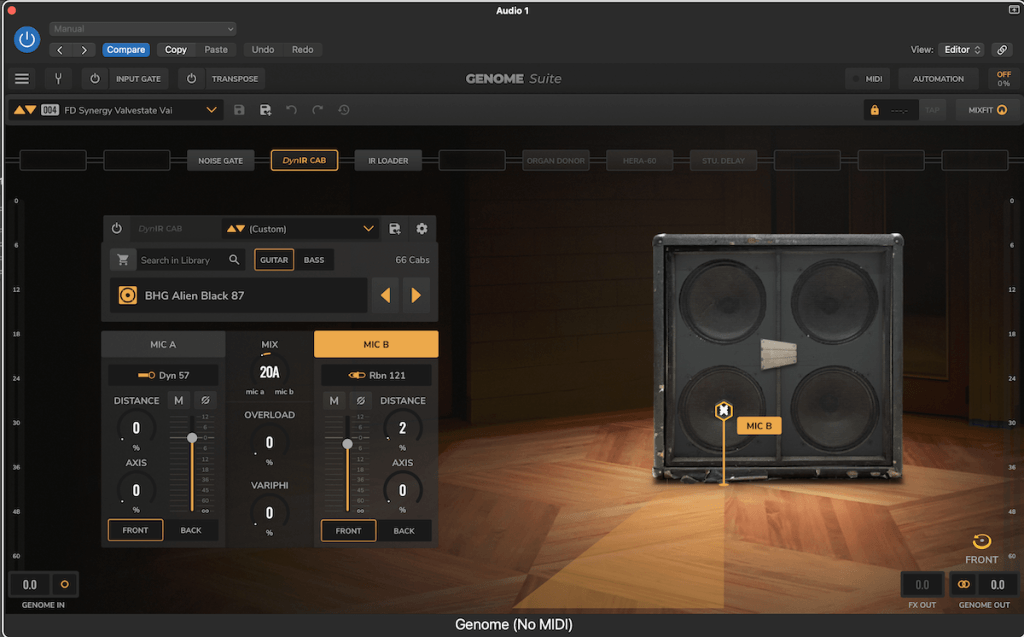
And this is exactly why I love software like Genome.
Although I use it for cab sims you can still change the sound a lot.
But the more you go “old style” the less options you have.
In my case I’m using a tube pre and power amp.
A power soak and a vintage Marshall cabs with mics.
This means a large part of my sound is actually already recorded.
If you record with just a DI track (clean) you can always use a modeler like Genome to change everything to your hearts content. But although I love Genome (and other modelers) I still feel that the “old style” chain sounds much better and more powerfull.
So how do I keep my options open.
One thing I can change after the fact is my mic choice.
I’m using the Slate Digital system, which means I can “change mics” (more characters) after the recording.
Of course I can still use EQ or Genome new guitar strip (awesome addition).
But it’s very limited, if I record with too much gain or missing frequenties I’m done, it will never sound perfect.
So what if….. I could record my own track exactly again?
Not possible, sorry…. unless I can output the DI track through my total guitar chain.
I’ve tried this via my interface (terrible noise and sound), a buffered pedal (also not working without a lot of noise) and there I just decided to stop there and get a re-amping box.
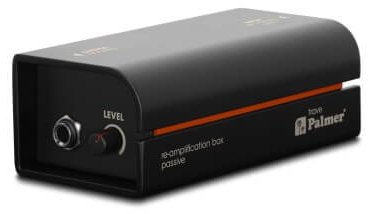
I ended up with the very affordable Palmer Trave
I’ve watched several videos and in all honesty I could not find any reason to spend more money on a re-amp box.
The Palmer has all the bells and whistles and it was actually one of the best in a recent comparison so I ordered the Palmer. And did not regret it.
Why fake it when you can create it?
One thing I see a lot online is people trying to “fix” guitar tones with EQ plugins, saturation plugins, enhancer plugins, magic plugins, miracle plugins, and probably a few plugins that promise to make coffee while you’re mixing. In all honesty most of them do enhance the sound, but as with photography I like to get it right in camera (while recording).
Sometimes they work.
Sometimes they don’t.
But here’s the thing.
If the amp sound itself isn’t right, you’re treating symptoms instead of solving the problem.
Wouldn’t it be easier if you could simply try a different amplifier?
With re-amping, you can.
Not by faking it.
By actually creating a new recording from the same performance..
That’s the difference.
My new favorite home studio trick
Is running my DI track through the re-amp box and choosing the final sound during the mix/mastering.
But I’m very lucky that we don’t have any neighbors that complain.
Most home studio owners have the same common challenge.
Neighbors.
Now, if you’re lucky, your neighbors love heavy guitar music at midnight.
If you’re really lucky, they bring snacks.
Most of us are not that lucky.
So what happens?
You record quietly.
You use amp simulators.
You keep the volume down.
Nothing wrong with that.
But here’s where things get interesting.
Let’s say you record a clean DI signal while tracking.
Now you can take that recording anywhere.
A friend’s studio.
A commercial studio.
A rehearsal room.
Even your garage if that’s where the good amp lives.
The guitarist doesn’t need to be there.
The performance is already captured.
You simply send the recording back through an amplifier and record it again.
Same playing.
Different tone.
It’s a bit like taking a RAW file into Photoshop and deciding later whether the image should be dramatic, bright, moody, or cinematic. The original information is still there.
You’re just making creative decisions later in the process.
So what does a re-Amp box actually do?
Now for the slightly technical part.
Don’t worry.
I promise there won’t be a test.
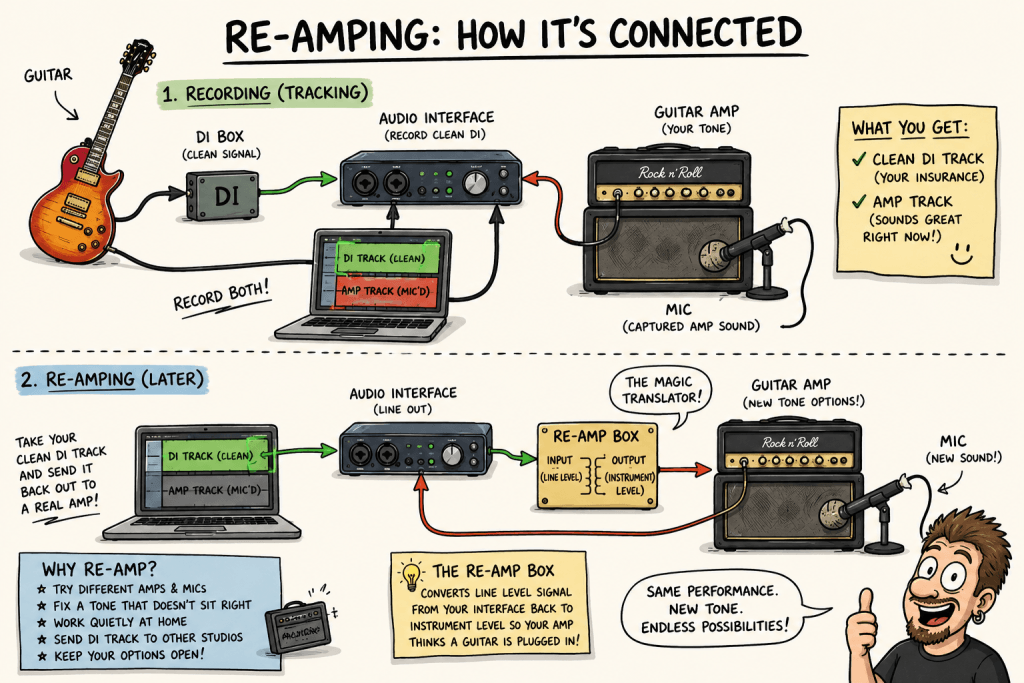
Your audio interface outputs a line-level signal.
A guitar amplifier expects an instrument-level signal.
Those are not the same thing.
Sending the interface output directly into the amplifier is a little bit like trying to fit a square peg into a round hole.
Sometimes it works.
Usually it works badly.
A re-amp box sits between the interface and the amplifier.
Its job is to convert the recorded line-level signal back into the type of signal a guitar amplifier expects.
In simple terms:
The amplifier believes a guitar is plugged into it.
Meanwhile your guitarist is probably sitting on the couch watching Netflix.
Technology is wonderful.
The workflow is easier than most people think
When you hear re-amping, you might imagine a room full of cables that somehow lead to a small electrical fire.
It’s actually very straightforward.
In my case I use a splitter that will send one part of my signal through the whole chain, and one part goes straight into the sound interface. You can split it before anything, or for example after your WAH, or maybe even after your boost pedals.
Do remember that you can always later add the WAH and boost pedals.
So for a WAH I would probably split after it if it’s a vital part of my track, otherwise I will probably keep it as clean as possible.
Also because all amps respond differently to my WAH.
When recording:
Guitar → Splitter → DI Box → Interface
Via the splitter :
Guitar → Splitter → Amp → Cabinet → Microphone → Interface
Now you have two recordings.
One is the finished amp sound.
The other is a clean DI track.
It could be the original track is perfect, in that case make sure to keep the DI just in case you might change your mind.
But if you want to Re-amp the setup is super simple.
In your DAW you select the DI track and send this to an output on your interface.
The Re-amp box is connected to your interface and you connect your guitar chain to the re-amp box.
That’s it.
No black magic.
No secret engineering handshake.
Just signal flow.
It’s important of course that in your DAW you record the Re-amped signal just the way you would normally record your complete setup. You can even dial in your amp while the track is playing, or how about lowering or raising settings while playing?
Real Amps, plugins or both?
This is where things get fun.
And where the internet starts arguing.
Personally, I think we’re living in an amazing time.
Modern amp simulators sound fantastic.
The days when digital guitar tones sounded like angry bees trapped inside a tin can are mostly behind us.
For many productions, software is more than good enough.
But there is still something special about a real amplifier moving air in a room.
A speaker interacts differently.
Microphones behave differently.
Rooms contribute their own character.
Sometimes that little bit of unpredictability is exactly what makes a recording come alive.
My recommendation?
Use everything.
Record a DI.
Use an amp simulator while writing and mixing.
If the track needs something extra, re-amp it through a real amplifier later.
Why limit yourself?
Now you can also play that killer solo in the garden with a plug-in but re-amp it with a blend of your favorite amps and cabs.
Final thoughts
For me creating music is a passion but mostly hobby.
If it sound great I’m happy, when it sounds perfect I’m really happy
So in essence a plugin would work like a charm.
But as mentioned before a real tube amp, a real cab and mic they just sound different.
Add to this the “magic” of vintage gear and I think it all adds to the inspiration.
Spending several hundreds on a re-amp box is not worth it for me personally.
However the Palmer Trave is priced under $100,00 which makes it a no brainer if you love to play with different amps, cabs or mics.
Blending amps can create an awesome sound. And because you re-amp you can do it without any phasing issues when you use the same cabs and mics of course.
My track Vanilla Gorilla is the first track where I blended several amps via Re-amping